
Where Is the Tummy Tuck Scar Located? Can It Be Hidden Underwear?
One of the first questions many people ask before considering a tummy tuck is simple but very understandable: “Where will the scar be?” This is not just a cosmetic concern. A tummy tuck, also known as abdominoplasty, may affect how a person feels in underwear, swimwear, fitted clothing, or even in their own body after pregnancy, weight changes, or abdominal skin laxity.
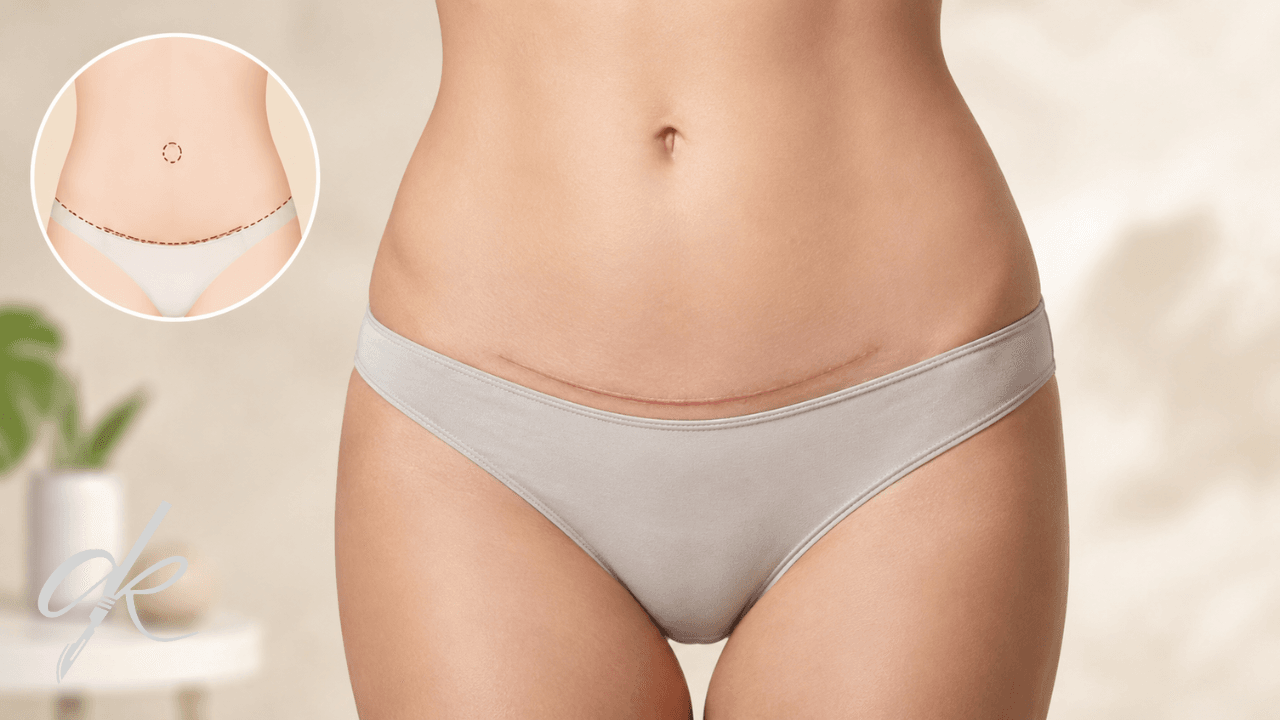
In a tummy tuck procedure, the incision is usually planned in the lower abdomen, close to the pubic area, so that it can often be concealed under underwear or bikini bottoms. However, the exact position, length, and shape of the scar are not the same for every patient. The amount of excess skin, abdominal looseness, belly button position, previous C-section scar, body proportions, and skin quality all affect surgical planning.
In a full tummy tuck, the scar is generally longer and may extend from one hip area toward the other. In a mini tummy tuck, the incision is usually shorter and may sometimes be close to an existing C-section scar. In full abdominoplasty, there may also be a scar around the belly button because the navel often needs to be repositioned. In mini abdominoplasty, the belly button is usually not repositioned, so a belly button scar may not be necessary.
So, does the scar disappear completely? No. Like any surgical incision, a tummy tuck leaves a scar. But with careful planning, proper surgical technique, appropriate wound care, sun protection, and individual healing characteristics, the scar may gradually become lighter, softer, and less noticeable over time.
This article explains where a tummy tuck scar is usually located, how it can be planned to remain under underwear, how it may relate to a C-section scar, and the difference between mini and full tummy tuck scars. The information is prepared in line with the expertise of Dr. Ahmet Kaplan, a Plastic, Reconstructive and Aesthetic Surgeon in Istanbul, Turkey.
Why Does a Scar Form After a Tummy Tuck?
A tummy tuck is a surgical procedure that aims to remove excess abdominal skin, tighten loose tissues, and, in suitable patients, support the abdominal wall. To remove excess skin, an incision must be made. This incision naturally heals as a scar.
The important point is this: scarring is a normal part of surgical healing. Claims such as “scarless tummy tuck” are not medically realistic. However, the location of the incision, the closure technique, tissue tension, and postoperative care may influence how visible the scar becomes over time.
Think of it like tailoring a garment. If fabric needs to be tightened, the extra part must be removed. A skilled tailor places the seam where it will be least noticeable and most compatible with the shape of the garment. In tummy tuck surgery, the same logic applies. The incision is usually planned in the lower abdomen, where it may be hidden under underwear.
Where Exactly Is a Tummy Tuck Scar Located?
A tummy tuck scar is usually located in the lower abdomen, close to the pubic line. It is generally designed as a horizontal line that sits low enough to be covered by underwear or bikini bottoms. However, this does not mean the scar will be placed in the exact same position for every patient.
Some patients have excess skin mainly below the belly button. Others have looseness extending from the upper abdomen to the lower abdomen. The greater the amount of loose skin, the more tissue may need to be removed, and this may affect the length of the incision.
In a full tummy tuck, the scar often extends across the lower abdomen, sometimes from one hip bone area toward the other. In some patients, it may be shorter. In others, it may need to extend further toward the sides.
The goal is not only to hide the scar. The incision must also be placed in a way that allows safe tissue movement, balanced closure, and healthy healing. A low scar is desirable, but tissue safety always comes first.
How Is the Scar Planned to Stay Under Underwear?
Planning the scar under underwear begins before surgery. During consultation, the surgeon evaluates the patient’s standing posture, skin excess, abdominal fold, previous scars, underwear line, and overall abdominal structure. This matters because the abdomen looks different when lying down compared to standing.
The incision is usually marked carefully before surgery. The aim is to place it as low and as discreetly as possible within safe surgical limits. However, it would not be accurate to say that every tummy tuck scar can be hidden under every underwear or bikini style.
Very low-rise underwear or certain bikini cuts may reveal part of the scar. This is why it can be helpful for patients to discuss their clothing preferences with their surgeon before the procedure. Some patients prefer high-waisted underwear; others prefer low-rise styles. These expectations should be evaluated realistically during planning.
Is the Tummy Tuck Scar a Straight Line?
Although a tummy tuck scar is often described as a horizontal line, it does not always look like a perfectly straight line. In many cases, it may have a gentle curve that follows the natural lower abdominal and pubic contour. This can make the scar more compatible with underwear lines and body shape.
The shape of the scar is not determined only by aesthetic preference. It depends on how much skin needs to be removed, how the abdominal skin moves, where the belly button is positioned, whether previous scars exist, and how the tissues can be safely closed.
Some patients naturally ask for the shortest possible scar. This is understandable. But in patients with significant excess skin, making the incision too short may limit proper tissue removal or create unnecessary tension. A shorter scar is not always a better scar. A correctly positioned and appropriately planned scar is more important.
Can a Tummy Tuck Scar Be Combined with a C-Section Scar?
Patients who have previously had a C-section often ask: “Will the tummy tuck scar be placed over my C-section scar?” In some cases, yes. If the old C-section scar is located within the area of skin to be removed, it may be removed together with the excess skin or included in the new incision line.
However, this is not always possible. A C-section scar may be too high, too low, uneven, thick, pulled inward, or attached to deeper tissues. In tummy tuck surgery, the main factor is where and how much skin needs to be removed safely.
If the C-section scar is in a suitable position, the new abdominoplasty incision may be planned close to it. If it is not in a favorable location, the surgeon may need to plan a new incision line that provides better tissue safety and aesthetic balance.
So, the answer is not the same for every patient. A previous C-section scar can sometimes be incorporated into tummy tuck planning, but this decision requires a personal examination.
Why Is Planning Different in Patients with a C-Section Scar?
A C-section scar is not only a visible line on the skin. It may also involve deeper tissue changes, adhesions, firmness, or pulling under the skin. These factors can affect tummy tuck planning.
Some patients develop a fold of skin above the C-section scar, especially after pregnancy or weight changes. This fold may be one of the reasons they consider abdominal contouring. During a tummy tuck evaluation, the surgeon assesses the skin, fat tissue, scar quality, and tissue mobility in that area.
In some cases, the old scar may be removed. In others, the new incision may be placed slightly above or below it. The decision is based not only on appearance but also on blood supply, tissue safety, and how much abdominal skin can be moved.
Where Is the Mini Tummy Tuck Scar Located?
A mini tummy tuck is usually considered when excess skin is limited mainly to the area below the belly button. Because the surgical area is smaller, the incision is often shorter than in a full tummy tuck.
In some patients, the mini tummy tuck scar may be similar in length to a C-section scar. It is typically placed low in the lower abdomen, close to the pubic area. However, this varies from patient to patient.
A mini tummy tuck is not suitable for everyone. If there is significant looseness above the belly button, widespread skin excess, or abdominal wall laxity extending beyond the lower abdomen, a mini tummy tuck may not be enough. In such cases, a full tummy tuck may be more appropriate.
Where Is the Full Tummy Tuck Scar Located?
In a full tummy tuck, the incision is usually longer and placed across the lower abdomen. Depending on the amount of skin excess, it may extend toward both hip areas. In addition, because the belly button often needs to be repositioned, there may also be a scar around the navel.
A full tummy tuck addresses both the upper and lower abdomen. This is why the incision may need to be longer than in a mini tummy tuck. The procedure is more comprehensive, and the scar reflects the extent of correction required.
Many patients worry about the belly button scar. In full abdominoplasty, this scar is usually planned within the natural folds and contour of the navel so that it becomes less noticeable as healing progresses. Still, like any scar, it requires time to mature.
Mini Tummy Tuck vs Full Tummy Tuck Scar: What Is the Difference?
The main difference between mini and full tummy tuck scars is related to the scope of surgery. A mini tummy tuck focuses on a more limited area, so the incision is usually shorter. A full tummy tuck addresses a wider area, so the incision is generally longer.
In a mini tummy tuck, there is usually no scar around the belly button because the navel is often not repositioned. In a full tummy tuck, a belly button scar is commonly part of the procedure because the abdominal skin is moved and the navel must be brought through the new skin position.
However, it would be misleading to say, “Mini tummy tuck leaves less scar, so it is always better.” The right procedure depends on the patient’s anatomy. If a patient needs full correction but chooses a mini procedure only to have a shorter scar, the result may not address the actual problem adequately.
Who May Be Suitable for a Mini Tummy Tuck?
A mini tummy tuck may be considered for patients who have limited excess skin mostly below the belly button. It may also be suitable for some patients with mild lower abdominal looseness and relatively good upper abdominal skin quality.
For example, a patient who has a small lower abdominal skin fold after pregnancy, stable weight, and no major looseness around the belly button may be evaluated for mini abdominoplasty. But this is only a general example. Suitability must be determined through examination.
A mini tummy tuck should not be seen as a “minor” or “simple” operation. It is still a surgical procedure and requires careful planning, realistic expectations, and proper follow-up.
Who May Need a Full Tummy Tuck?
A full tummy tuck may be considered in patients with more widespread abdominal skin excess, looseness above and below the belly button, or abdominal wall separation after pregnancy or major weight changes. It allows the surgeon to address a larger area of the abdomen.
In full abdominoplasty, the belly button often becomes part of the surgical plan. Since the upper abdominal skin is moved downward, the navel usually needs to be repositioned. That is why a belly button scar may be expected.
The purpose is not only to remove extra skin. The surgeon evaluates abdominal shape, skin quality, tissue laxity, old scars, muscle separation, and the patient’s expectations together. A full tummy tuck scar may be longer, but in appropriate patients, it may allow a more comprehensive correction.
How Does a Tummy Tuck Scar Change Over Time?
A tummy tuck scar does not look the same on the first day and after one year. In the early weeks, the scar may appear pink, red, firm, or slightly raised. This is often part of the normal wound healing process.
Over the following months, the scar gradually matures. Its color may fade, firmness may decrease, and the line may become softer. In some people, this process progresses relatively quickly. In others, scar maturation may take longer.
Not every scar heals the same way. Genetics, skin type, smoking, diabetes, infection, sun exposure, nutrition, and wound care can all influence scar appearance. Some scars become thin and pale; others may remain more visible.
Does a Tummy Tuck Scar Disappear Completely?
No, a tummy tuck scar does not disappear completely. Every surgical incision leaves some degree of scar. However, it may become less noticeable over time.
This is why realistic expectations are very important. The goal is not to promise “no scar.” The goal is to place the scar as discreetly as possible, close the tissues carefully, support healing, and manage the scar properly during recovery.
For some patients, a low abdominal scar hidden under underwear may feel acceptable compared to the discomfort of loose abdominal skin. For others, scarring may be a more sensitive concern. This should be discussed openly before surgery.
Why Are Some Tummy Tuck Scars More Noticeable?
Every body heals differently. Some people develop very fine, pale scars. Others may develop thicker, darker, raised, or wider scars. This may be related to surgical technique, but it is also strongly influenced by individual healing biology.
People prone to hypertrophic scars or keloids may develop more raised scars. Some skin types may be more likely to develop pigmentation changes. Smoking can reduce blood flow to healing tissues and may negatively affect wound healing.
Tension on the incision line can also affect scar quality. This is why heavy lifting, sudden movements, and early intense activity are usually restricted after surgery. A healing incision should not be pulled or stressed too early.
How Should Tummy Tuck Scar Care Be Managed?
Scar care after a tummy tuck should follow the surgeon’s instructions. Not every cream, silicone gel, tape, or skincare product is suitable for every patient. Timing matters, and the wound must be properly closed before certain scar treatments are started.
In general, keeping the incision clean, avoiding picking at scabs, protecting the area from sun exposure, and attending follow-up appointments are important parts of care. Some patients may be advised to use silicone sheets or silicone gel, but this should be decided individually.
Sun protection is especially important. A new scar may darken if exposed to sunlight too early. Even if the scar is usually covered by clothing, extra care may be needed during warmer months or travel.
Can Underwear Choice Affect the Scar?
In the early recovery period, the type of compression garment and underwear should be selected according to the surgeon’s recommendation. Underwear that rubs directly on the incision, creates pressure, or irritates the healing line may cause discomfort.
Long term, underwear choice mainly affects scar visibility. High-waisted underwear may cover the scar more easily, while very low-rise styles may reveal part of it. This is why discussing clothing preferences before surgery can be useful.
Some patients even bring their preferred bikini or underwear style to consultation. This can help the surgeon understand the patient’s expectations and plan within realistic surgical limits.
Will There Be a Scar Around the Belly Button?
In a full tummy tuck, there is often a scar around the belly button. This is because the abdominal skin is pulled downward and the navel needs to be brought through the new skin position.
The belly button scar is usually designed to sit within the natural shape and folds of the navel. In the early period, it may look red or noticeable. With time, it may soften and become less visible.
In a mini tummy tuck, the belly button is usually not repositioned. Therefore, a belly button scar may not be necessary. However, this depends on the patient’s anatomy and surgical plan.
Is a Tummy Tuck Scar Visible in Clothes?
In everyday clothing, a tummy tuck scar is usually not visible because it is placed low on the abdomen. Pants, skirts, leggings, and underwear often cover it. However, some bikinis, very low-rise clothing, or special lingerie cuts may reveal part of the scar.
So, it would not be accurate to say that the scar will never be visible in any clothing. Clothing style matters.
Still, placing the scar in the lower abdomen rather than the visible central abdomen offers an important advantage. In many daily situations, the scar can remain hidden.
Can Previous Abdominal Surgery Scars Affect a Tummy Tuck?
Yes, previous abdominal scars may affect tummy tuck planning. C-section, appendix surgery, hernia repair, gallbladder surgery, laparoscopy scars, or other abdominal procedures may influence tissue movement and blood supply.
During examination, the surgeon evaluates where the scars are, how they healed, whether they are attached to deeper tissues, and whether they fall within the area of skin to be removed.
Some old scars may be removed during the tummy tuck. Others may remain or change position. This is why patients should inform their surgeon about all previous abdominal surgeries, even if the scars seem small.
Is Scar Revision Sometimes Needed?
In some patients, scars may heal wider, thicker, raised, or irregular. This does not mean scar revision should be done immediately. Scar maturation takes time, and early judgment can be misleading.
Usually, the appearance of the scar is evaluated after it has matured over several months. If the scar remains significantly noticeable, scar treatments or scar revision may be considered if the surgeon finds it appropriate.
However, not every scar requires additional treatment. Scar management is personal and should be guided by a plastic surgeon.
What Helps a Tummy Tuck Scar Heal Better?
The first rule is to follow the postoperative care plan recommended by the surgeon. Keeping the incision clean, attending follow-up visits, and avoiding unnecessary tension on the scar are important.
Smoking may negatively affect wound healing because it can reduce blood flow to tissues. Patients should discuss smoking cessation before and after surgery with their surgeon.
Nutrition also matters. A balanced diet with adequate protein, vitamins, and minerals may support tissue repair. However, supplements should not be used without medical approval, especially around surgery.
Why Are Realistic Expectations So Important?
Before undergoing a tummy tuck, patients should think not only about the abdominal contour but also about the scar. For some people, a low scar hidden under underwear may be acceptable. For others, any scar may feel emotionally significant.
This is why the preoperative consultation is so important. Patients should openly discuss their clothing habits, previous scar healing, concerns about visibility, and expectations.
Sometimes a small conversation about scar placement can prevent major disappointment later. When patients know what to expect, they usually manage the recovery period more calmly and realistically.
The Importance of Personalized Scar Planning with Dr. Ahmet Kaplan in Istanbul, Turkey
Scar planning is one of the key steps in tummy tuck surgery. The scar is not simply something that appears after surgery; it is something that should be carefully planned before surgery.
Dr. Ahmet Kaplan, a Plastic, Reconstructive and Aesthetic Surgeon in Istanbul, Turkey, evaluates abdominal structure, skin excess, previous C-section or surgical scars, underwear line, tissue quality, and healing characteristics when planning abdominoplasty. This personalized approach helps determine the most suitable surgical plan for each patient.
The aim is not to encourage a procedure, but to help patients considering tummy tuck surgery understand scar location, scar length, healing expectations, and the differences between mini and full abdominoplasty. A well-informed patient can make more conscious decisions and follow the recovery process more comfortably.
Conclusion: Tummy Tuck Scar Planning Requires Realistic Expectations
A tummy tuck scar is usually placed in the lower abdomen, close to the pubic line, where it can often be hidden under underwear. In a mini tummy tuck, the scar is usually shorter. In a full tummy tuck, the scar is generally longer and may include an additional scar around the belly button.
For patients with a previous C-section scar, the old scar may sometimes be incorporated into the new incision line or removed with excess skin. However, this depends on scar position, tissue quality, and the surgical plan.
The scar does not disappear completely, but it may become lighter, softer, and less noticeable over time. Proper surgical planning, wound care, sun protection, avoiding smoking, and regular follow-up all play important roles.
If you are considering a tummy tuck in Istanbul, Turkey, it is helpful to discuss scar placement openly during your consultation. Understanding where the scar may be, how long it may be, and how it may heal can make the entire process more realistic and reassuring.
Frequently Asked Questions
Where is a tummy tuck scar located?
A tummy tuck scar is usually located in the lower abdomen, close to the pubic area. It is generally planned low enough to be hidden under underwear or bikini bottoms, but the exact position varies from patient to patient.
Can a tummy tuck scar be hidden under underwear?
In many cases, yes. The incision is usually planned to remain under underwear. However, very low-rise underwear or certain bikini styles may reveal part of the scar.
Does a tummy tuck scar disappear completely?
No. Like any surgical incision, a tummy tuck leaves a scar. Over time, the scar may fade, soften, and become less noticeable, but it does not disappear completely.
Can a C-section scar be removed during a tummy tuck?
In some patients, yes. If the C-section scar is within the area of skin to be removed, it may be removed or incorporated into the new incision line. This depends on personal anatomy and surgical planning.
Is a tummy tuck scar placed in the same area as a C-section scar?
Sometimes it may be close to the C-section scar, but not always. The final incision line depends on skin excess, scar position, tissue quality, and safety considerations.
Is a mini tummy tuck scar shorter?
Generally, yes. A mini tummy tuck usually involves a shorter incision because it addresses a more limited area below the belly button. However, suitability must be determined by examination.
Does a full tummy tuck leave a scar around the belly button?
In many full tummy tuck procedures, yes. Since the belly button is often repositioned, a scar around the navel may be part of the procedure.
How long does it take for a tummy tuck scar to fade?
Scar maturation may take several months. In some patients, the scar continues to improve for a year or longer. Healing speed varies from person to person.
Why do some tummy tuck scars become raised?
Raised scars may be related to genetics, skin type, wound tension, infection, smoking, or individual healing response. A plastic surgeon should evaluate scars that become thick, painful, or unusually raised.
When should scar care begin after a tummy tuck?
Scar care should begin only when the surgeon says it is appropriate. Creams, silicone gels, tapes, or other products should not be used without medical approval.
Can sunlight affect a tummy tuck scar?
Yes. Sun exposure may darken a new scar and make discoloration more noticeable. Protecting the scar from sunlight is important during healing.
Can laser treatment improve a tummy tuck scar?
In some cases, laser or other scar treatments may be considered. The right timing and method should be determined by a plastic surgeon after examination.