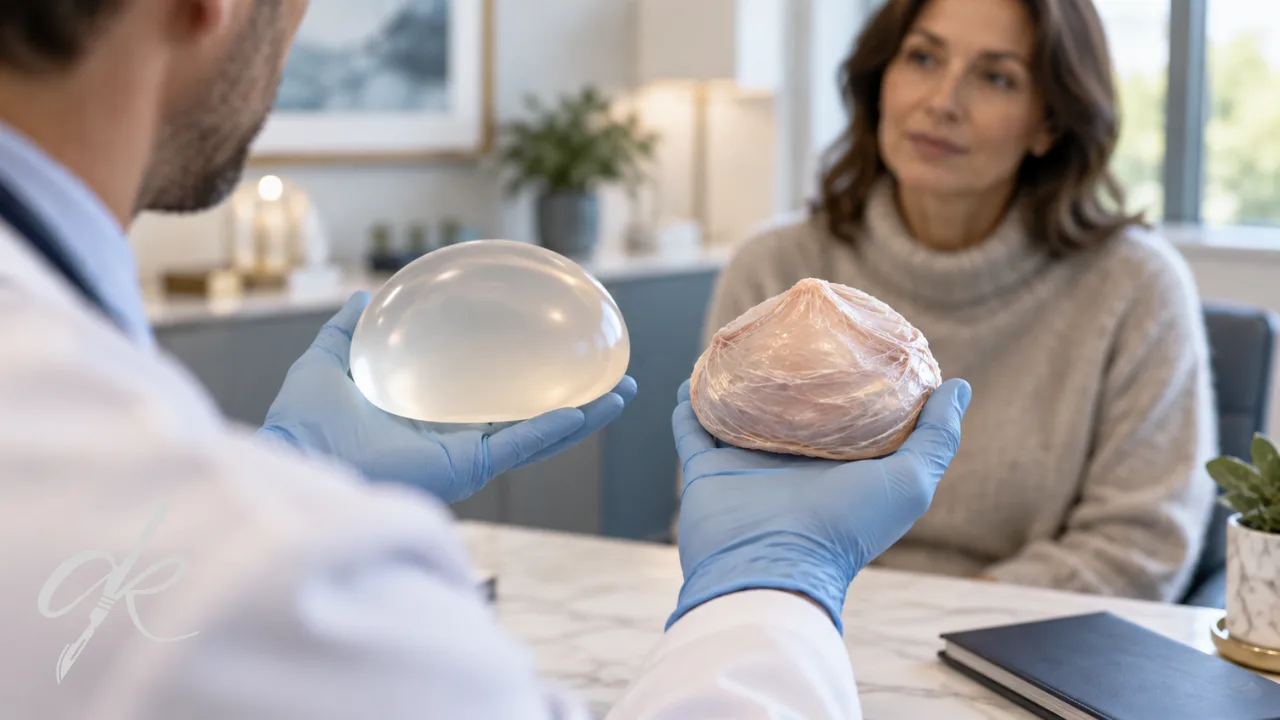
Forming a capsule around an implant is a normal and expected process; the problem arises when that capsule thickens and tightens. This is capsular contracture, with an overall reported incidence of 10.6%. Severity is graded using the Baker classification, and grades III and IV generally call for surgery. The most consistently supported preventive measures are submuscular placement and antibiotic pocket irrigation.
It is usually noticed months, sometimes years, after surgery.
The breast gradually becomes firmer. The shape changes, riding higher on the chest. In some patients pain follows.
And the first thought is usually: “Has my implant failed?”
The problem is not the implant — it is the tissue around it.
First, what is a capsule?
This is the most commonly misunderstood point.
When the body encounters something that is not its own, it surrounds it with a thin layer of fibrous tissue. This is the capsule.
It is not a complication. It is expected, normal and in fact useful — it holds the implant in position and separates it from surrounding tissue.
Everyone with a breast implant forms a capsule.
So when does it become a problem?
As long as the capsule stays thin, soft and pliable, it causes no symptoms.
In some patients, however, this tissue thickens, hardens and contracts. A contracting capsule compresses the implant.
This is capsular contracture, and its consequences are:
- The breast feels firm to the touch
- The shape rounds off and rides higher
- The implant edges become visible
- In advanced cases, pain develops
How common is it?
Published sources report an overall incidence of 10.6%.
That figure varies substantially by patient group. It is markedly higher in reconstruction patients who have received radiotherapy, and lower in healthy patients undergoing cosmetic augmentation.
Baker grading
| Grade | Examination | Appearance | Pain | Approach |
|---|---|---|---|---|
| Baker I | Soft | Natural | None | No intervention |
| Baker II | Slightly firm | Looks normal | None | Monitoring |
| Baker III | Firm | Distorted | Usually none or mild | Surgery considered |
| Baker IV | Markedly firm | Clearly distorted | Present | Surgery |
As the literature states, grades III and IV usually call for capsulectomy or capsulotomy.
The distinction sits here: in Baker II the breast feels firm but looks normal. In Baker III the appearance has changed too. That is the decisive threshold.
When does pain appear?
Generally at grades III and IV.
The description in the literature: the tightening capsule exerts pressure on surrounding tissues and nerves. Pain is characterised as tightness, burning or sharp discomfort that may radiate to the arm or chest wall.
It may be felt during physical activity, with pressure on the breast, and in severe cases even at rest.
Why does it happen? The biofilm hypothesis
There is no single established cause, but one mechanism stands out.
Biofilm — subclinical bacterial contamination — is described as one of the leading suspected causes.
The mechanism
A small number of bacteria reaching the implant surface during surgery form a biofilm layer. This produces no signs of infection: no fever, no redness, no discharge.
But the body mounts a persistent, low-grade inflammatory response to it.
And that chronic response causes the capsule to thicken and contract over time.
This also explains why contracture can appear months or years after surgery.
A second mechanism cited is chronic inflammation from the foreign body response itself.
Risk factors
Placement plane
The general position: subglandular placement — above the muscle, beneath breast tissue — is described as associated with higher contracture rates than submuscular placement.
And on prevention: submuscular placement and antibiotic pocket irrigation are among the most consistently supported ways to lower the risk.
But there is a newer finding
A systematic review and meta-analysis published in the Aesthetic Surgery Journal in January 2026 examined 33 studies comparing subfascial and subglandular placement.
The result was not what was expected:
- For smooth implants, no statistically significant difference between the two planes
- For textured implants, likewise no significant difference
- In studies published since 2015, still no significant difference
The authors’ interpretation is notable: the perceived advantage of subfascial placement may reflect historical implant selection rather than the surgical plane itself.
What this means: the submuscular advantage is a separate question and remains supported. But differences between the planes above the muscle may be less clear-cut than assumed.
Implant surface: advice that has become outdated
This section matters, because a claim still in circulation no longer holds.
The older view: textured implants were reported to show lower contracture rates than smooth ones — some comparisons cited 3-14% for textured against 6-20% for smooth.
But the picture changed.
In 2019, Allergan Biocell textured implants were recalled over BIA-ALCL risk — a lymphoma associated with implants and linked to macro-textured surfaces.
Practice consequently shifted toward smooth devices for most cosmetic cases.
And the warning in current sources is explicit: the advice to switch from smooth to textured implants in order to reduce recurrence is outdated.
Sources also note that textured implants have shown higher rates in some studies and lower in others — the data is not one-directional.
The conclusion: implant choice is determined case by case, not by a blanket rule.
Other risk factors
- Haematoma and seroma. Blood or fluid around the implant creates a pro-inflammatory environment in the critical early weeks.
- Radiotherapy. Reconstruction patients receiving radiation face substantially elevated risk; radiation accelerates fibrosis in surrounding tissue.
- Infection. Any infection around the implant sharply increases risk.
- Previous contracture. A prior episode raises the chance of recurrence.
- Genetic predisposition. Some patients appear intrinsically more prone to fibrotic responses; keloid formers may carry elevated risk.
- Oversized implants. Excessive pocket tension and tissue stretching elevate risk.
Prevention: the 14-Point Plan
As the biofilm hypothesis gained ground, a standard preventive protocol emerged: the Adams 14-Point Plan.
Sources describe it as an internationally recognised standard for minimising biofilm during breast implant surgery.
Its logic is stated simply: keep bacterial contamination as close to zero as possible from the moment the implant is opened until the wound is closed.
Its principal elements include preoperative antibiotics, appropriate site preparation, avoiding nipple contamination, meticulous haemostasis, avoiding entry into breast tissue, pocket irrigation, preventing skin contact with the implant, use of an insertion sleeve, opening the implant package at the last moment, minimising handling, appropriate incision choice, avoiding drains, layered closure, and antibiotic prophylaxis before later procedures.
A practical suggestion: ask at consultation which protocol is used to minimise biofilm. It sounds technical, but the clarity of the answer is informative.
Pocket irrigation
Antibiotic pocket irrigation is among the most consistently supported measures. Irrigation with hypochlorous acid has also been proposed, with one study showing a significant reduction in incidence at one year.
Treatment options
Grades I and II generally require no intervention; monitoring is sufficient. Surgery comes into consideration at grades III and IV.
Capsulectomy
Subtotal (partial) capsulectomy excises only a portion of the capsule — often the anterior scar tissue. It minimises surgical trauma but leaves some capsule in place.
Total capsulectomy removes the entire capsule and is described as traditionally recommended for significant contractures (Baker III/IV), to eliminate all scar tissue.
Capsulotomy
Releasing the capsule by incision rather than removing it. A more limited procedure, used in selected cases.
Implant exchange
Often performed concurrently with capsulectomy. Type, size or profile may be changed.
Pocket change
An important option for reducing recurrence: relocating the implant to a different plane — for example from above the muscle to below it.
Sources also describe a neopocket technique, in which a new pocket is created between the old capsule and the muscle, with the old capsule collapsed against the chest wall.
Support materials
Acellular dermal matrix may be used to reinforce the pocket and reduce recurrence risk, with reported benefit particularly in reconstruction.
Removal without replacement
In severe or recurrent cases, some patients choose removal without replacing the implant.
Recurrence
Honesty is required here: recurrence after treatment is possible, and a previous episode raises that likelihood.
For this reason a second operation should address not only removal of the capsule but the underlying risk factors: change of plane, reconsideration of implant choice, and rigorous application of biofilm-prevention measures.
When to seek assessment
- Progressive firmness
- Change in shape, riding higher
- New asymmetry between the breasts
- Pain or a sensation of tightness
- Discomfort radiating to the arm or chest wall
- Implant edges becoming visible
- Sudden swelling or redness — which suggests something different
The last is a separate category. Sudden swelling, redness and fever suggest infection or fluid collection and warrant prompt assessment.
Sources also note that other implant problems can occur alongside or be mistaken for a tightening capsule. Firmness alone is not diagnostic.
For patients who had surgery abroad
A practical section, because contracture often presents long after the patient has returned home.
Obtain your implant records if you can. The manufacturer, model, size, surface type and placement plane all shape what is recommended now. Many patients receive an implant card at discharge; if you have one, keep it. If you do not, request the operative details from the clinic that performed the surgery.
This matters practically. Whether the implant was smooth or textured affects both the discussion of BIA-ALCL surveillance and the choice of replacement. Whether it sits above or below the muscle determines whether a change of plane is an option.
Assessment does not require returning to the original surgeon. Contracture is diagnosed on examination, and a local assessment can establish the grade and what is needed. Where surgery is required, it can be planned wherever you choose — but it is planned better with the records.
In summary
Capsule formation around an implant is normal and occurs in everyone. The problem arises when that capsule thickens and contracts, compressing the implant. Overall incidence is reported as 10.6%.
Severity is graded by the Baker classification, and the decisive threshold is Baker III: firmness accompanied by a change in appearance. Pain generally appears at grades III and IV.
The leading mechanism is biofilm — subclinical bacterial contamination producing a persistent low-grade inflammatory response. Prevention therefore centres on protocols that minimise biofilm.
On placement, the submuscular advantage remains supported. However, a 2026 meta-analysis found no significant difference between the planes above the muscle, suggesting the perceived advantage may reflect historical implant selection.
On implant surface, the older advice no longer holds: following the withdrawal of macro-textured implants over BIA-ALCL risk, practice has shifted to smooth devices.
Treatment options include capsulectomy, capsulotomy, implant exchange and change of plane. Recurrence is possible, so a second procedure should address risk factors and not only the capsule.
If you have noticed firmness or a change in shape, you can arrange a consultation. Procedures are outlined on the treatments page.
Frequently Asked Questions
Is forming a capsule normal?
Yes. The body surrounds anything foreign with fibrous tissue, and this occurs in everyone with an implant. The problem arises only when the capsule thickens and contracts.
How common is capsular contracture?
Sources report an overall incidence of 10.6%. This varies by patient group and is markedly higher in reconstruction patients who have received radiotherapy.
What is the Baker classification?
A system grading severity from I to IV. Baker I is soft and natural, II slightly firm but normal-looking, III firm with distorted appearance, and IV markedly firm and painful. Grades III and IV generally require surgery.
Why does it happen?
The leading mechanism is biofilm: bacteria reaching the implant surface form a layer that produces no signs of infection, but the body mounts a persistent low-grade inflammatory response that thickens the capsule over time.
Does placement plane affect risk?
Subglandular placement is described as associated with higher rates than submuscular. However, a 2026 meta-analysis found no statistically significant difference between the planes above the muscle, suggesting the perceived advantage may reflect historical implant selection.
Do textured implants reduce risk?
That advice is outdated. Macro-textured implants were recalled in 2019 over BIA-ALCL risk and practice shifted to smooth devices. Implant choice is determined case by case.
What reduces the risk?
Submuscular placement and antibiotic pocket irrigation are the most consistently supported measures. The Adams 14-Point Plan is described as an internationally recognised standard for minimising biofilm.
Can it come back after treatment?
Yes, and a previous episode raises that likelihood. A second procedure should therefore address underlying risk factors — change of plane, implant choice — and not only the capsule itself.
Dr. Ahmet Kaplan — Specialist in Plastic, Reconstructive and Aesthetic Surgery. A graduate of Hacettepe University Faculty of Medicine, he obtained his specialist title in 2020 and passed the European Board of Plastic, Reconstructive and Aesthetic Surgery (EBOPRAS) examination in 2022. Based in Istanbul. About Dr. Kaplan
This content is for informational purposes only and does not replace medical examination, diagnosis or treatment. Results vary between individuals.
References
- Abbott EN, et al. Capsular Contracture Rates in Subfascial and Subglandular Breast Augmentation With Smooth vs Textured Implants. Aesthetic Surgery Journal, January 2026.
- Understanding Capsular Contracture: Mechanisms, Management, and Patient Outcomes. PRS Global Open. PMC12803722.
- Adams WP. The 14-Point Plan for biofilm minimisation in breast implant surgery.
- Capsular Contracture — overview of risk factors across 40 studies. ScienceDirect Topics.