
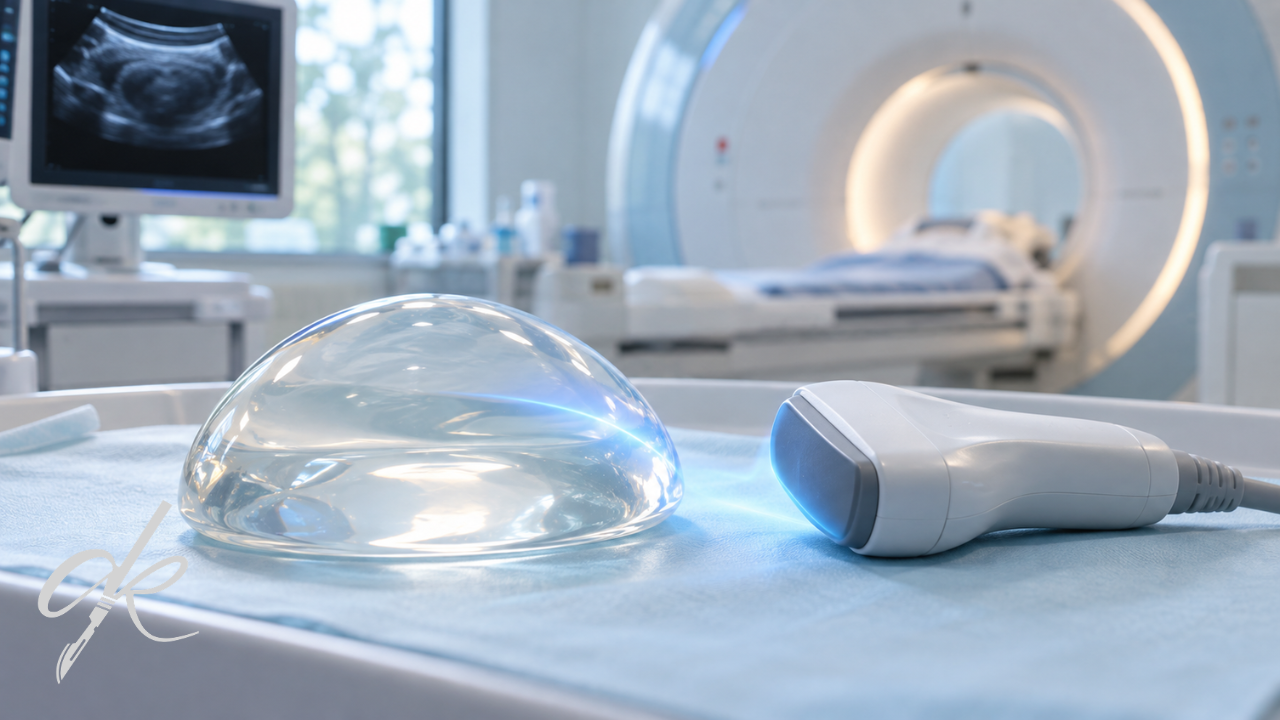
No — and the source of that belief is a warranty period, not a clinical recommendation. As published reviews note, the FDA does not recommend a formal timeline for the routine replacement of breast implants. But implants are also not considered lifetime devices. What is recommended is not routine replacement but routine surveillance: for asymptomatic patients with silicone gel implants, an ultrasound or MRI at 5-6 years, then every 2-3 years thereafter.
Almost everyone who has, or is considering, breast implants has heard the same sentence:
“They have to be replaced every ten years.”
It is widely repeated, stated with confidence, and has no clinical basis.
But the opposite is not true either — implants are not devices that last indefinitely.
The short answer: two statements are true at once
| Common belief | Reality |
|---|---|
| “Replace every 10 years” | No formal timeline for routine replacement is recommended |
| “Once placed, they last forever” | Implants are not considered lifetime devices |
These do not contradict each other. Together they mean:
If your implants are causing no problem, they are not replaced according to a calendar. But neither is it assumed they will last indefinitely.
What is recommended is not replacement — it is surveillance.
Where did the “10-year rule” come from?
Two sources are identified, and neither is medical.
1. Manufacturer warranties
The explanation in published sources is direct: many implant manufacturers originally offered 10-year warranties, which led to the assumption that implants “expire” at that point.
A warranty period is a commercial term — not a medical definition of a device’s working life.
2. Older-generation implants
As sources note: older-generation implants had higher rupture rates, which helped fuel the misconception that all implants needed routine replacement at 10 years.
Modern cohesive silicone implants demonstrate markedly improved durability.
And the data does not support the myth
A 2011 FDA report found that only one in five patients required a revision after 10 years.
So four out of five needed nothing at the ten-year mark.
What is actually recommended?
Not routine replacement — routine imaging.
And the reason comes down to one phenomenon: silent rupture.
What is silent rupture?
When a silicone gel implant ruptures, the patient usually does not notice.
The figure is striking: only 30% of gel implant ruptures present with clinically detectable findings on physical examination.
Which means roughly 70% are silent.
Why isn’t it noticed?
There is a mechanical reason.
The gel in modern silicone implants is cohesive — it holds together rather than flowing. Even when the outer shell tears, the gel stays in place and is usually contained by the capsule around the implant.
As sources put it: with silicone implants, rupture is much more challenging to detect as it is rare to have a completely collapsed implant shell.
Saline implants are different
A rupture in a saline implant is immediately noticeable: the implant deflates and the sterile saline is safely absorbed by the body, typically within days.
For this reason, the FDA imaging recommendation applies to silicone gel implants only. For saline, regular physical examination is considered sufficient.
The FDA surveillance recommendation
| Situation | Recommendation |
|---|---|
| Asymptomatic, silicone gel | First ultrasound or MRI: 5-6 years after surgery Then: every 2-3 years |
| Symptomatic | MRI |
| Ultrasound findings unclear | MRI |
This applies to both cosmetic augmentation and reconstruction patients.
Why did the recommendation change?
The 2006 guideline: MRI at 3 years, then every 2 years.
Two problems emerged.
First, timing. The new guidance reflects research indicating that ruptures are more likely to occur 6 years after silicone devices are implanted. Three years was early.
Second, compliance. And this is the more striking part.
Published research found that neither providers nor patients followed the recommendations: only 37.7% of surgeons followed the FDA guidelines, with 55.0% not recommending MRI unless clinical issues arose.
The reason is stated plainly: MRI costs US$2,000-6,000 and is often an out-of-pocket expense after cosmetic breast augmentation.
Ultrasound was therefore added as an acceptable option.
The lesson here extends beyond medicine: a recommendation that cannot be followed protects less than one that can.
Ultrasound or MRI?
| Ultrasound | MRI | |
|---|---|---|
| Sensitivity | Adequate | Gold standard |
| Intracapsular rupture | More limited | Superior |
| Cost | Markedly lower | High |
| Radiation | None | None |
| Access | Easy | Limited |
MRI is described as the gold standard for detecting silicone implant rupture, with higher sensitivity and specificity than ultrasound, particularly for intracapsular ruptures.
However, American College of Radiology criteria state that in a patient with concern for rupture, ultrasound or MRI without contrast is usually appropriate.
In practice: ultrasound first-line, MRI if needed.
An honest note on consensus
There is no international agreement on this.
Sources state it plainly: European societies oppose routine breast implant imaging.
So while the FDA recommends routine screening, some European professional bodies do not support it.
This divergence matters. It is one more reason the surveillance plan should be decided with your surgeon rather than assumed.
This is not mammography
Sources emphasise this specifically: implant surveillance does not replace breast cancer screening or mammography. The two serve different purposes and are planned separately.
How often does rupture occur?
Reported rates vary considerably — and that variation is itself informative.
- The FDA cites approximately 10% risk over 10 years (around 1% cumulative per annum)
- One source reports 5-13% at 10 years, depending on brand and implant type
- A review reports 8.7-24.2% at 10 years
This range reflects differences in implant generation, brand and type. Sources note that modern cohesive silicone implants demonstrate markedly improved durability.
The common thread: risk increases with device age. But that does not mean automatic replacement in a given year.
When is replacement actually needed?
1. Rupture is detected
Replacement comes into consideration when imaging shows a rupture — including when there are no symptoms.
2. Capsular contracture
Thickening and tightening of the capsule around the implant requires surgery at Baker grades III and IV, usually planned together with implant exchange.
3. Change in appearance
- New asymmetry
- Implant malposition
- Rippling or visible folds
- Change in size or shape
4. Tissue changes
Over the years, weight change, pregnancy, breastfeeding and natural ageing alter breast tissue. The result can change even when the implant has not.
Here replacement is driven not by the implant failing but by its surroundings changing.
5. Patient preference
A patient wanting a different size or type may request exchange without a medical indication.
6. Removal without replacement
Some patients choose removal rather than exchange.
If a rupture is found without symptoms
This situation is increasingly common, because the more surveillance is performed, the more silent ruptures are found.
The general approach is assessment of the finding and discussion of replacement or removal.
But one detail shows the decision is individual: a recent review recommends discontinuing surveillance and routine implant exchange after age 75, given the limited clinical impact of silent ruptures in older patients.
So even “every rupture requires surgery” is not absolute. The decision weighs age, general health, rupture type and patient preference together.
A practical surveillance plan
| When | What |
|---|---|
| Annually | Self-check and clinical examination |
| Years 5-6 | First ultrasound or MRI (silicone gel) |
| Thereafter | Imaging every 2-3 years |
| Any time | Seek assessment promptly if something changes |
| Separately | Continue age-appropriate breast cancer screening |
And one practical point: keep your implant card. Manufacturer, model, size, surface type and placement plane all affect every decision that follows.
For patients who had surgery abroad
Worth a section, because implants outlast the trip by decades.
Obtain and keep your implant records. If you do not have an implant card, request the operative details from the clinic that performed the surgery — ideally now rather than in fifteen years, when the clinic may no longer be reachable.
Surveillance does not require returning to the original surgeon. Ultrasound and MRI are performed wherever you live, and the results can be interpreted by any qualified practitioner. What makes that interpretation better is knowing what was implanted.
Ask who you contact if something is found. A clinic that will respond to a question five years later is worth identifying before you need one.
“I have no problems — do I still need a scan?”
The answer to this question summarises the whole article.
Yes — because having no problems does not mean having no rupture.
Given that only 30% of gel implant ruptures produce findings on examination, “I feel fine” is not a substitute for imaging.
That is the entire reason the recommendation exists.
In summary
“Replace every ten years” is not a clinical recommendation. Published sources attribute the belief to manufacturer warranties and the higher rupture rates of older-generation implants. A 2011 FDA report found only one in five patients required revision after 10 years.
The FDA does not recommend a formal timeline for routine replacement. But implants are also not considered lifetime devices.
What is recommended is surveillance: for asymptomatic patients with silicone gel implants, ultrasound or MRI at 5-6 years, then every 2-3 years. MRI is recommended where there are symptoms or where ultrasound is unclear.
The reason is silent rupture: only 30% of gel implant ruptures produce detectable findings on examination.
Two honest caveats: there is no international consensus — European societies oppose routine imaging — and implant surveillance does not replace breast cancer screening.
Replacement is indicated when rupture is found, when capsular contracture develops, when appearance changes, when surrounding tissue changes, or by patient preference — not by the calendar.
If you would like your implants and surveillance plan reviewed, you can arrange a consultation. Procedures are outlined on the treatments page.
Frequently Asked Questions
Do breast implants need replacing every 10 years?
No. Published sources state the FDA does not recommend a formal timeline for routine replacement. The belief is attributed to manufacturer warranties and the higher rupture rates of older-generation implants.
So can they last forever?
No. The FDA states that breast implants are not considered lifetime devices and may at some point need removal or replacement.
How often should I be scanned?
For asymptomatic patients with silicone gel implants: a first ultrasound or MRI at 5-6 years after surgery, then every 2-3 years. MRI is recommended where symptoms exist or ultrasound findings are unclear.
What is silent rupture?
A rupture producing no symptoms. Only 30% of gel implant ruptures present with clinically detectable findings on examination. Modern cohesive gel does not flow, so appearance may be unchanged.
Do saline implants need imaging too?
The FDA imaging recommendation applies to silicone gel implants. Saline rupture is immediately noticeable — the implant deflates and the contents are absorbed within days. Regular examination is considered sufficient.
Ultrasound or MRI?
MRI is described as the gold standard, but American College of Radiology criteria state ultrasound or MRI without contrast is usually appropriate. In practice ultrasound is first-line, with MRI if needed.
Is there international consensus?
Not entirely. Published sources note that European societies oppose routine breast implant imaging. The plan should be decided with your surgeon.
When is replacement actually needed?
When rupture is detected, when capsular contracture develops, when appearance changes significantly, when surrounding tissue changes, or by patient preference — not because a particular year has been reached.
Dr. Ahmet Kaplan — Specialist in Plastic, Reconstructive and Aesthetic Surgery. A graduate of Hacettepe University Faculty of Medicine, he obtained his specialist title in 2020 and passed the EBOPRAS examination in 2022. Based in Istanbul. About Dr. Kaplan
This content is for informational purposes only and does not replace medical examination, diagnosis or treatment. Surveillance plans depend on implant type and individual circumstances.
References
- Management of Asymptomatic Breast Implant Rupture in Older Adult Patients: A Scoping Review. PRS Global Open. PMC13282052.
- ACR Appropriateness Criteria® Breast Implant Evaluation: 2023 Update.
- Current State of Evidence-Based Long-Term Monitoring Protocols for Breast Plastic Surgery Patients. PMC11466996.
- FDA. Breast Implants — Risks and Complications, updated guidance.