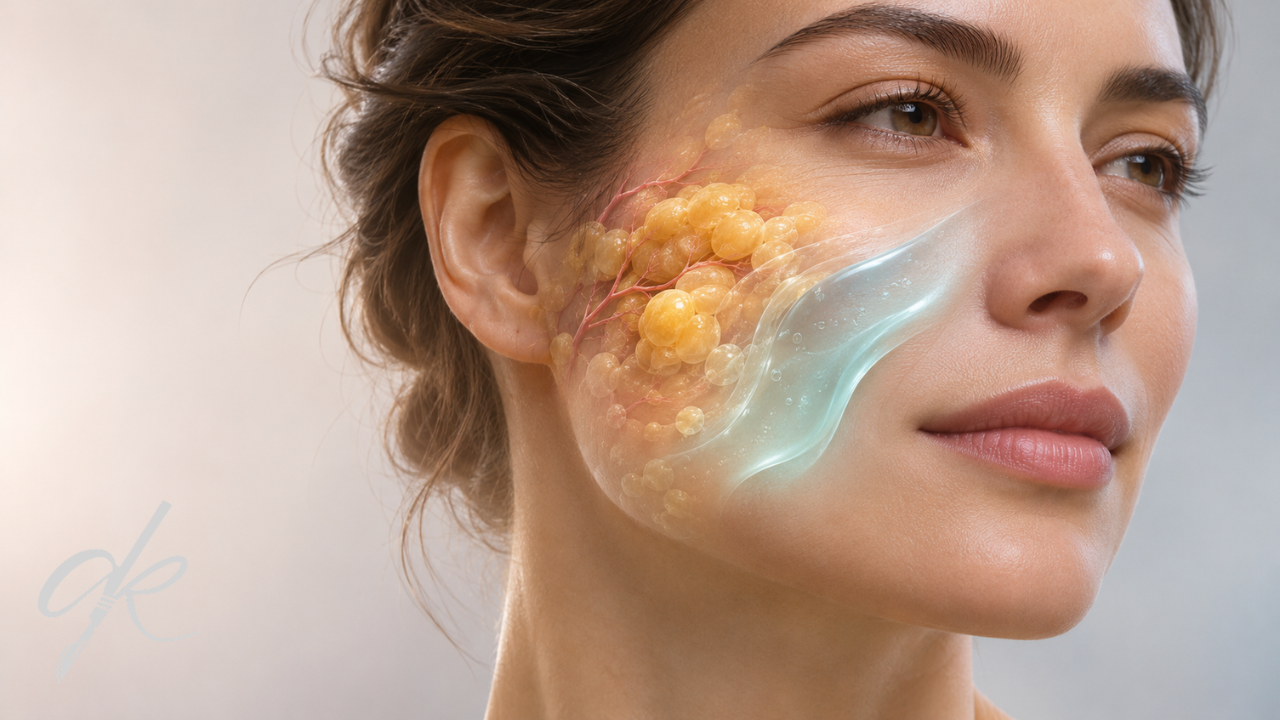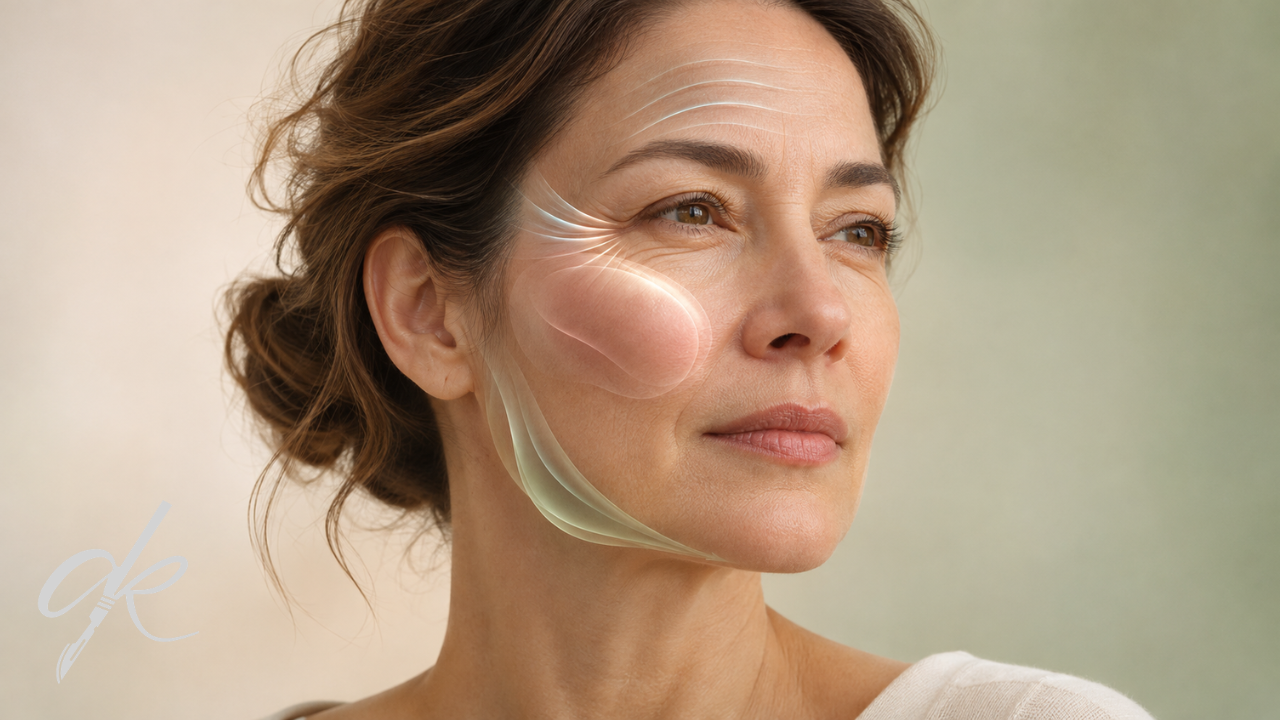
The threshold is not your age or how pronounced the problem is — it is the type of problem. Botulinum toxin addresses muscle movement and filler addresses volume loss; neither corrects structural descent. In one study, neuromodulator use stayed at 100% after facelift surgery while filler use fell from 90% to 60%. That pattern shows directly what each tool treats: surgery does not stop movement, and injections do not lift descended tissue.
A sentence heard often at consultation:
“I don’t want surgery.”
That is an entirely legitimate preference. But an assumption usually sits behind it — that injectables are an intermediate step that postpones surgery.
The literature does not support that assumption, and the reason is not that injectables are weak.
The question is not “surgery or injections”
Three distinct things change in the face with age, and each has a different answer.
| Type of problem | How it presents | What addresses it |
|---|---|---|
| Movement-related (dynamic) lines | Appear on expression, disappear at rest | Botulinum toxin |
| Volume loss | Hollowing, with no excess skin | Volume support |
| Structural descent and excess skin | Tissues have moved downward; skin is in excess | Not corrected by volume |
The third row is the reason for this article.
The threshold is not how pronounced the complaint is, but which category it belongs to. Volume loss is treated with volume however advanced it is; structural descent is not treated with volume however mild it is.
The data supports this: what continues after surgery?
The study
A retrospective review of records from 20 women who had undergone facelift surgery compared injectable use before and after the operation. Average age at surgery was 55.95.
| Treatment | Before surgery | After surgery |
|---|---|---|
| Neuromodulator | 100% | 100% |
| Filler | 90% | 60% |
| PLLA | 55% | 35% |
| Microfocused ultrasound | 65% | 15% |
What the table says
Neuromodulator use did not fall at all. A facelift does not remove muscle movement; expression lines continue to form afterwards.
Filler use dropped markedly. When the structural component is corrected surgically, part of the need that was being compensated with volume disappears.
These two rows read almost as an empirical answer to “which method treats which problem”.
And one more figure
Patients had used injectable treatments for an average of 7.55 years before surgery. For hyaluronic acid filler the average was 7.11 years, with a range of 2 to 17 years.
Note: The study does not interpret this period as “delaying surgery” and did not examine whether patients used injectables in order to postpone an operation. It reports the duration only.
⚠️ The study’s limits
- Only 20 patients, single centre, pilot study
- No control group
- All patients female
- Product type, volume, injection plane and sites inconsistently documented
- Outcomes based on a brief patient survey
- The authors describe the findings as preliminary and state they do not permit causal conclusions
So the table indicates a pattern; it does not establish a rule.
What injectables can address
Botulinum toxin
By reducing muscle contraction, it targets movement-related lines. One review describes the intended effect as “movement modulation, not tissue destruction”.
The distinguishing test here is simple: does the line persist with the face at rest, or appear only on expression? Lines that appear only with movement fall within this method’s scope.
Volume support
Where there is volume loss without accompanying excess skin, volume support is an appropriate approach.
Hyaluronic acid is also reported to stimulate fibroblasts and collagen production in photodamaged skin — so its effect may not be limited to mechanical filling.
And one advantage
Hyaluronic acid is the only filler group that can be dissolved with hyaluronidase. Non-hyaluronic products such as calcium hydroxylapatite cannot.
That makes hyaluronic acid the volume option with the lowest irreversibility risk — although, as below, dissolution has its own cost.
What injectables cannot address: structural descent
Why this is not a volume problem
In volume loss, tissue has diminished; in structural descent, tissue has moved downward. It is a question of position, not quantity.
Adding volume beneath descended tissue does not lift it — it makes it fuller where it already sits.
And the literature treats this as an error
A review of the overfilling picture lists, among its causes, directly this:
Treating structural descent or skeletal asymmetry with volume.
So this is not described as the method falling short — but as the method being applied to the wrong problem.
The same review notes that severe midface ptosis may require deep-plane surgery.
The filler you think has gone may still be there
MRI findings
In a study in which 33 patients who had received hyaluronic acid filler to the mid-face were assessed by magnetic resonance imaging, images were reviewed by two blinded radiologists.
| Finding | Result |
|---|---|
| Patients with filler detected | All 33 |
| Complete dissipation within the 2-year post-injection period | Seen in none |
| Not injected for 2-5 years | 21 patients |
| Not injected for over 5 years | 12 patients |
| Longest reported longevity | Up to 15 years |
The study explicitly challenges the widely held view that hyaluronic acid fillers last 3-12 months, and suggests refilling protocols may need reconsidering.
⚠️ The limits of this finding
- The sample was selected: 24 asymptomatic patients and 9 with oedema concerns. The second group is enriched for people experiencing problems.
- Patient numbers are small and the authors call for larger cohorts.
- Being detectable on imaging does not have to mean producing a clinical volume effect — these are not the same thing.
The practical consequence still matters
Another publication notes that imaging studies have detected residual hyaluronic acid months and, in some reports, years after treatment, and that regarding hyaluronic acid as “temporary and reversible” does not hold in every case.
The overfilling review puts it this way: repeated top-ups without accounting for residual product can lead to delayed overfilling appearing months or years later.
So each session you add may be adding not to zero, but to a base you cannot see.
Facial overfilled syndrome: a defined entity
The “heaviness” that comes up in these conversations is not an abstract worry; it is a described clinical picture.
How it is defined
The review describes it as a recognisable iatrogenic disorder presenting with “profound distortion of natural facial topography” and “dynamic expressional impairment”.
Reported features
| Feature | Description |
|---|---|
| Midface widening | Increased lateral facial width |
| Blunted jawline | Loss of definition |
| Loss of transitions | Nasolabial and tear trough transitions effaced |
| “Stiff smile” | Restricted movement on expression |
| “Frozen yet bulky” appearance | Both immobile and overfull |
| Persistent oedema | Swelling that does not resolve |
| Flattened philtral columns | Upper lip columns splayed and flattened |
Affected areas include the midface and lateral cheek, jawline, nasolabial folds, tear trough and periorbital region, lower eyelid, lips and perioral region.
🔴 The mechanism: where the “weight” comes in
The explanation reported in the review (Lim et al.):
Mechanical failure of the facial retaining ligaments under the chronic weight of excessive hydrophilic filler.
In the review’s words, fillers “overwhelm the structural integrity of the facial retaining systems”.
Note the word hydrophilic — water-attracting. The volume placed is not a fixed quantity; its load can change over time through water retention.
Other causes
- Excessive quantity, wrong anatomical plane, or inappropriate rheology — high G-prime product in superficial mobile areas, hydrophilic product in oedema-prone areas
- Treating structural descent with volume
- Ethnic mismatch, such as over-projecting the midface
- Patient demand shaped by social media
- Failure to decline inappropriate requests, and inadequate screening
⚠️ And the review’s own caveat
The review states plainly that standardised definitions, diagnostic criteria and management protocols remain insufficiently codified.
The picture is recognised, but there is no agreed diagnostic standard. That limit should be held in mind.
🔴 But this should not be overstated
This section matters as much as the rest.
That facial overfilled syndrome is defined does not validate every claim circulating about injectables. Three common claims:
1. “Filler stretches the face and ages you faster”
A review examining this question mechanically states that the concept it proposes is “not presented as a demonstrated adverse effect” and does not constitute evidence that fillers or toxin accelerate ageing.
The same review describes its proposals about tissue mechanics as a framework to be tested, not a diagnosis or established mechanism, and notes that no validated threshold exists.
So the accurate statement is that excessive quantity is associated with a defined picture — not that filler ages the face.
2. “If you have fillers you won’t be able to have surgery later”
In the facelift study above:
- No surgical complications were attributed to prior filler or biostimulator use
- No patient required filler dissolution before surgery
- Average satisfaction was 4.25 out of 5; 80% said they achieved their goal and would have the surgery again
The authors still stress that the small sample does not permit a definitive safety assessment. But the available data does not support this common concern.
3. “If I’m unhappy I’ll just have it dissolved”
There is an overlooked cost here.
The review states hyaluronidase should be given targeted and in micro-doses, ideally under ultrasound or MRI guidance, and not empirically.
Because over-dissolution can lead to a separate picture of laxity and contour loss (Wilde et al.).
Non-hyaluronic products cannot be dissolved with this enzyme; some cases may require surgical or device-assisted debulking.
So being reversible does not mean being without cost.
Which findings indicate the surgical threshold?
The core question
Is this a problem of quantity or of position?
| Finding | Which category it points to |
|---|---|
| Line appears only on expression | Movement — unrelated to volume |
| Area is hollow, no excess skin | Volume loss |
| Excess skin present; resolves when stretched | Structural — not corrected by volume |
| Tissues descended; added filler makes the area fuller but does not lift it | Structural |
| Each session lasts less and the quantity keeps rising | Possible method-problem mismatch |
| The face widens but the intended contour does not emerge | Warning toward overfilling |
| Deeply established lines present at rest | Beyond movement treatment alone |
Three warning signs
- Rising quantity, shortening duration. More product each time, shorter result.
- Fullness without contour improvement. The area is fuller but the intended border or transition does not emerge.
- Expression has changed. The smile or other movements are not as they were.
These three are not a diagnosis; they point to a question that should be asked at examination.
Note: These distinctions cannot be made by self-assessment. Excess skin, tissue position and volume status are distinguished only by examination.
If you would rather avoid surgery
That preference is entirely legitimate, and this article is not intended to change it.
1. The injectable option does not disappear
In the data above, neuromodulator use remained at 100% after surgery. Surgery does not replace injectables — the two can work alongside each other. That weakens the “either/or” framing.
2. If the problem is volume, surgery may not be needed at all
This article is not intended to steer anyone toward surgery. Where there is volume loss without excess skin, volume support is the appropriate approach — however advanced it is.
3. The risk comes from mismatch, not from the method
The overfilling review attributes the picture not to “using filler” but to applying volume to a structural problem and topping up without accounting for residual product.
What creates risk is not having injectables — it is having them before the category of the problem has been determined.
Worth discussing at consultation
- In my case, is the problem volume, position or movement? This determines everything else.
- Do I have excess skin?
- How much filler have I had, and where? With dates and sites if possible.
- Could some of my previous filler still be present? Would imaging help?
- Can the change I want be achieved with volume, or does it require a change of position?
- If I continue with injectables, what should I expect? Which complaints resolve and which remain?
- What are my options if I am unhappy, and what are the risks of dissolution itself?
- I’ve noticed a change in my expression — should that be assessed?
Summary
The threshold is not age or severity but the type of problem. Movement-related lines, volume loss and structural descent are different problems. Volume loss is treated with volume however advanced; structural descent is not treated with volume however mild.
The data supports this. In a study of 20 facelift patients, neuromodulator use remained at 100% after surgery while filler use fell from 90% to 60%. Surgery does not stop movement; injections do not lift descent. Patients had used injectables for an average of 7.55 years beforehand. The study is small and preliminary and does not establish causation.
Overfilling is a defined picture. It presents with midface widening, a blunted jawline, loss of transitions, a stiff smile and persistent oedema. The reported mechanism is mechanical failure of the facial retaining ligaments under the chronic weight of excessive hydrophilic filler. Its causes include, directly, “treating structural descent with volume”.
And the filler you believe has gone may still be present. In a 33-patient MRI study, filler was detected in all patients, none showed complete dissipation over the 2-year period, and longevity of up to 15 years was reported. The sample was selected and small, and detectability is not the same as a clinical volume effect.
But it should not be overstated. The claim that filler accelerates ageing is not proven — the review examining it says so explicitly. Nor does the available data support the idea that prior filler prevents surgery: in that study no complications were attributed to it and no patient needed dissolution beforehand. Conversely, over-dissolution is reported to cause a separate picture of laxity and contour loss.
Which category your own findings fall into can be determined by assessing excess skin, tissue position, current volume status and your previous treatments together. That assessment requires examination by a physician. If you would like your own case assessed, you are welcome to arrange a consultation.
Frequently Asked Questions
When are Botox and fillers no longer enough?
When the problem is not volume loss but structural descent or excess skin. Adding volume beneath descended tissue does not lift it; it makes it fuller where it sits. The threshold is the type of problem, not its severity.
If I have surgery, will I no longer need Botox?
In a study of 20 facelift patients, neuromodulator use remained at 100% after surgery. A facelift does not remove muscle movement, so expression lines continue to form. In the same study filler use fell from 90% to 60%.
Does filler really disappear in 6-12 months?
In a study assessing 33 patients who had mid-face hyaluronic acid filler by MRI, filler was detected in all patients and none showed complete dissipation over the 2-year post-injection period; longevity of up to 15 years was reported. The sample was small and selected. Being detectable on imaging also does not mean it is producing a clinical volume effect.
Does excessive filler make the face heavy?
A defined overfilling picture exists in the literature, presenting with midface widening, a blunted jawline, loss of transitions, a stiff smile and persistent oedema. The reported mechanism is mechanical failure of the facial retaining ligaments under the chronic weight of excessive hydrophilic filler. The review also notes that standardised diagnostic criteria remain insufficiently codified.
Does filler stretch the face and age you faster?
This claim is not proven. A review examining the question mechanically states that the concept it proposes is not presented as a demonstrated adverse effect and does not constitute evidence that fillers or toxin accelerate ageing. What is defined is a picture associated with excessive quantity, not filler itself.
If I’ve had filler, can I still have surgery?
The available data supports this. In the 20-patient facelift study, no surgical complications were attributed to prior filler or biostimulator use and no patient required dissolution before surgery. The authors note the small sample does not permit a definitive safety assessment.
Can filler be dissolved if I’m unhappy?
Hyaluronic acid can be dissolved with hyaluronidase; non-hyaluronic products cannot. However hyaluronidase is reported to require targeted, micro-dosed administration, ideally under imaging guidance, and should not be given empirically. Over-dissolution can cause a separate picture of laxity and contour loss.
Which findings suggest surgery?
Excess skin, tissues that have descended, and an area that becomes fuller with added volume without being lifted. Rising quantity with shortening duration, fullness without contour improvement, and a noticed change in expression are also findings that warrant assessment.
I’ve had a lot of filler — what should I do?
An assessment with the quantities, sites and dates of previous treatments is appropriate. The review notes that repeated top-ups without accounting for residual product can lead to delayed overfilling, and that ultrasound or MRI assessment may be considered in some cases.
Is it wrong to continue with injectables?
No. The overfilling review attributes the picture not to using filler but to applying volume to a structural problem and topping up without accounting for residual product. Where there is volume loss without excess skin, volume support is an appropriate approach.
Op. Dr. Ahmet Kaplan — Specialist in Plastic, Reconstructive and Aesthetic Surgery.
This content is for information only, does not constitute medical advice and does not replace examination by a physician. The rates and findings cited come from published studies and carry the sample and methodological limitations described in the text; individual situations vary with anatomy, tissue characteristics, previous treatments and clinical circumstances.