
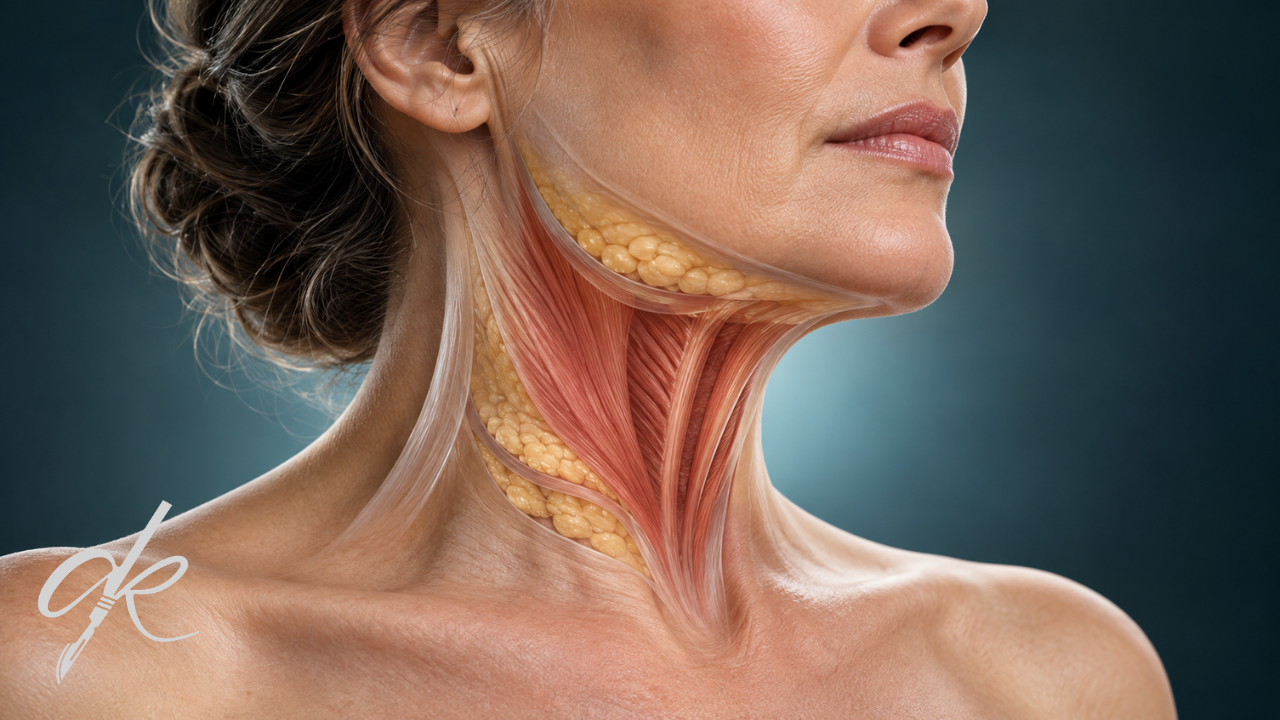
Ageing in the neck is not one problem but three independent ones: muscle (platysmal bands), fat, and skin. Which of these dominates determines the approach — and the fat itself sits in two separate layers, above and below the platysma muscle. Liposuction reaches only one of them. A neck lift can be performed on its own, but it requires specific criteria and will not correct jowling.
A sentence heard often in consultation:
“My face is fine, but my neck gives away my age.”
That observation is usually accurate. The neck changes at a different pace and through a different mechanism than the face.
But “neck lift” is not the name of a single operation. Depending on which structure is causing the problem, entirely different procedures are performed — and a mismatch between problem and procedure is the commonest reason results disappoint.
Three separate problems
| Problem | Structure | How it looks |
|---|---|---|
| Platysmal bands | Muscle | Two vertical cords down the front of the neck, more visible on speaking or straining |
| Excess fat | Fat tissue | Fullness under the chin — a “double chin” |
| Skin laxity | Skin | Sagging, horizontal lines, crepeing |
One person may have all three, another only one. Each requires a different intervention.
How platysmal bands form
The platysma is a broad, thin muscle covering the front and side of the neck. It is thicker in men and is a continuation of the SMAS layer of the face.
Its two halves meet in the midline. With age, the central fibres separate and the fascia supporting that junction weakens. The freed medial borders hang — and those are the visible vertical bands.
A pattern in which the muscle is fully split from the midline is considered an absolute indication for midline platysmaplasty.
Note: some recent work attributes the bands to muscular hyperactivity rather than to sagging and loss of tone. The mechanism remains debated.
Fat sits in two layers — and this changes everything
The two layers
- Subcutaneous fat: above the platysma
- Subplatysmal fat: beneath the muscle
From the outside both look identical: fullness under the chin.
But liposuction reaches only the subcutaneous layer.
In someone whose fullness comes largely from subplatysmal fat, liposuction leaves much of it in place — because the fat that needs removing lies beneath the muscle, and reaching it requires opening the muscle.
How the two are told apart
The examination manoeuvre is simple, and understanding it makes the logic clear.
The skin is pinched first at rest, then while the platysma is contracted.
| Tissue held on contraction | Suggests |
|---|---|
| Decreases | Excess subplatysmal fat — liposuction will not suffice |
| Stays similar or increases | Subcutaneous fat — liposuction may be effective |
The reasoning: when the muscle contracts, the fat beneath it is left behind, so only skin and the tissue above remain between your fingers. If what you can hold shrinks noticeably, the source lies deeper.
This is why “I have a double chin, will liposuction be enough?” cannot be answered before examination.
Can a neck lift be done on its own?
Yes — within a defined group.
Where it is considered suitable
- Adequate skin tone in the neck
- No significant jowling
- No midfacial laxity
- Small to moderate neck fat
- A situation liposuction cannot address — deep fat together with platysmal redundancy
- No wish for a full facelift
In terms of age, platysmaplasty is generally considered suited to patients between 40 and 60. Beyond 60, patients with significant excess neck skin and fat usually require additional procedures.
⚠️ What a neck-only procedure will not fix
- It will not correct jowling
- It will not suffice alone for major skin laxity
- It will not remove horizontal neck lines
- It may produce surface irregularities through unpredictable skin redraping
It is also described as highly technique-sensitive, with risks including seroma, haematoma and salivary gland complications.
When the two are combined
Combination is considered when these occur together:
- Significant subplatysmal fat
- Submental skin laxity
- Platysmal bands
- And jowling
The last item is decisive: where jowling is present, a neck-only procedure leaves the jawline mismatched.
The reverse case
A facelift without neck work is generally reserved for relatively thin patients with jowling and minimal submental skin or muscle laxity.
Otherwise, relapse of tissue laxity in the anterior neck 4 to 6 months after surgery has been reported.
Anatomy sets a ceiling
Structures that cannot be changed
Features of an ideal neck profile include a superior and posterior hyoid position, a well-projected chin and a defined inferior mandibular border.
Hyoid position is individual and anatomical. A low, anteriorly positioned hyoid limits how sharp the cervicomental angle can become.
Structures lying beneath
- Submandibular glands. Ptotic glands blur the definition of the jawline. They are assessed by looking for a bulge below the mandibular border, both at rest and on neck flexion.
- Anterior belly of the digastric muscle. When bulky, it contributes to submental fullness.
Neither is well addressed by anterior platysmaplasty. Gland reduction and partial digastric myectomy are described as separate ancillary procedures.
The cervicomental angle
The angle between the under-chin area and the neck is described as ideally 105 to 120 degrees.
It is determined not only by skin and fat but also by hyoid position, chin projection and the structures beneath.
The practical consequence: two people with identical skin quality can obtain different results because their anatomical foundations differ. This is a limit set by structure rather than technique, and it should be discussed before surgery.
Durability: three findings point the same way
Finding 1: long-term follow-up
Fifty patients, selected from more than a thousand deep plane facelifts, were assessed on pre-operative, early and average 5.5-year photographs. Measurement used both a computer program and independent observers; the two methods agreed.
The result: improvement in the lower face was maintained, while the neck drifted back toward its pre-operative position more than the other areas.
Finding 2: patient satisfaction
| Area | Score (0-100) |
|---|---|
| Nasolabial folds | 86.2 |
| Cheeks | 86.1 |
| Lower face and jawline | 86.0 |
| Neck | 78.1 |
| Under-chin area | 67.9 |
Finding 3: recurrence of bands
Platysmal bands becoming visible again is listed as a recognised late complication. Some surgeons, believing that midline closure alone can allow the muscle to drift downward, prefer lateral and superior suspension.
And the reason: the neck is not passive tissue
Tissue repositioned in the midface is largely passive. In the neck there is a muscle that works continuously.
The platysma moves when you speak, swallow, turn your head and change expression. A sutured muscle is a structure loaded thousands of times a day.
Two further factors: the submandibular gland and digastric muscle beneath are not addressed by the standard procedure, and hyoid position does not change.
This does not mean neck surgery should not be done. It means expectations should be set with this knowledge.
The delayed surprise of liposuction
1. Early results are not final results
Sources state it plainly: results that look good early may not reveal contour irregularities and changes in skin and muscle bands that appear six months or years later.
The reason is logical. Once fat is removed, the underlying muscle and skin become more visible. If skin tone is inadequate or bands lie beneath, liposuction can make them more apparent.
2. “A smaller procedure” is partly relative
Complications of submental procedures are described as closely resembling those of neck liposuction alone. The difference in risk may therefore be smaller than assumed.
What liposuction does not touch
| Problem | Liposuction |
|---|---|
| Subcutaneous fat | ✅ Reaches |
| Subplatysmal fat | ❌ Does not reach |
| Platysmal bands | ❌ No effect |
| Skin laxity | ❌ Does not correct — may accentuate |
| Ptotic submandibular gland | ❌ No effect |
| Hyoid position | ❌ Cannot be changed |
What to discuss at consultation
- Which structure dominates in my case? Muscle, fat, skin — or which combination?
- Which layer is the fat in? Was the pinch test performed?
- Is there jowling? If so, will a neck-only procedure be enough?
- Do my submandibular glands or digastric muscles limit the result?
- What ceiling does my hyoid position set?
- Which technique is planned for the bands, and what is the likelihood of recurrence?
- Is my skin tone adequate for liposuction, or would excess skin remain?
- What does recovery involve?
In summary
The neck is not one problem. Muscle, fat and skin can progress independently and each needs a different intervention. Where problem and procedure are mismatched, the result disappoints.
Fat sits in two layers and liposuction reaches only one. The two are distinguished by pinching the skin at rest and during platysmal contraction. If what can be held shrinks noticeably on contraction, the source lies beneath the muscle and liposuction will not suffice.
A neck lift can be done alone, but within criteria. Adequate skin tone, no significant jowling or midfacial laxity, small to moderate fat. Generally considered suited to ages 40 to 60. It does not correct jowling, major skin laxity or horizontal neck lines.
And on durability, three separate findings point the same way: at 5.5 years the neck regressed more than other areas; in satisfaction scoring the neck and under-chin ranked lowest; and recurrence of bands is a recognised late complication. The reason is anatomical — the neck is not passive tissue but a continuously working muscle, and the gland beneath and the hyoid position are not altered by the standard procedure.
Which structure dominates in your case, and which approach would suit it, can only be determined by examination. If you would like that assessed, you can arrange a consultation.
Frequently Asked Questions
What is the difference between a neck lift and a facelift?
A facelift mainly repositions tissue in the midface and along the jawline. A neck lift targets the platysma muscle, submental fat and neck skin. Which is needed depends on the presence of jowling, midfacial laxity and which structure dominates in the neck.
Why do platysmal bands form?
With age the midline fibres of the platysma separate and the supporting fascia weakens; the freed medial borders hang and form vertical bands. Some recent work attributes them to muscular hyperactivity rather than loss of tone.
Will liposuction be enough for my double chin?
It depends which layer the fat is in. Liposuction reaches only subcutaneous fat; fat beneath the platysma cannot be removed this way. The two are distinguished by pinching the skin at rest and during muscle contraction.
Can a neck lift be done on its own?
Within defined criteria: adequate skin tone, no significant jowling or midfacial laxity, small to moderate fat. It is generally considered suited to ages 40 to 60; beyond 60 with significant excess, additional procedures are usually needed.
Will a neck lift correct jowling?
No. A neck-only procedure is described as not correcting jowling, not sufficing alone for major skin laxity, and not removing horizontal neck lines.
How long do the results last?
The neck appears less durable than other facial areas. At an average 5.5 years, lower-face improvement was maintained while the neck drifted back more than other areas. In satisfaction scoring the neck scored 78.1 and the under-chin 67.9, against 86 and above elsewhere.
Why does the neck relapse sooner?
Tissue repositioned in the midface is largely passive, whereas the neck contains a continuously working muscle that moves with speech, swallowing and head movement. The submandibular gland and digastric muscle beneath are not well addressed by standard anterior platysmaplasty, and hyoid position does not change.
Can the bands come back?
Platysmal bands becoming visible again is listed as a recognised late complication. Some surgeons prefer lateral and superior suspension on the basis that midline closure alone may allow downward drift.
Does my anatomy limit the result?
It can. An ideal neck profile involves a superior and posterior hyoid position, which is individual. Ptotic submandibular glands blur the jawline and a bulky digastric contributes to submental fullness; neither is well addressed by anterior platysmaplasty.
What is the cervicomental angle?
The angle between the under-chin area and the neck, described as ideally 105 to 120 degrees. It is determined by hyoid position, chin projection and underlying structures as well as skin and fat.
Dr. Ahmet Kaplan — Plastic, Reconstructive and Aesthetic Surgeon.
This content is for information only, does not constitute medical advice and does not replace examination by a physician. The findings cited come from published studies and reviews; they describe group-level trends, and individual results vary with anatomy, tissue characteristics and clinical circumstances.