
“Ozempic face” is not a medical diagnosis — it is a lay term describing facial deflation after rapid weight loss. The underlying change is no different from normal facial ageing: the superficial and deep fat compartments empty out. It simply happens far faster. Treatment options range from fillers and fat transfer to surgery, depending on whether skin laxity accompanies the volume loss.
A particular complaint has become common in consultations: “I’m happy with my body, but my face has aged.”
It sounds contradictory at first. Weight loss is a health gain — why would the mirror be a problem?
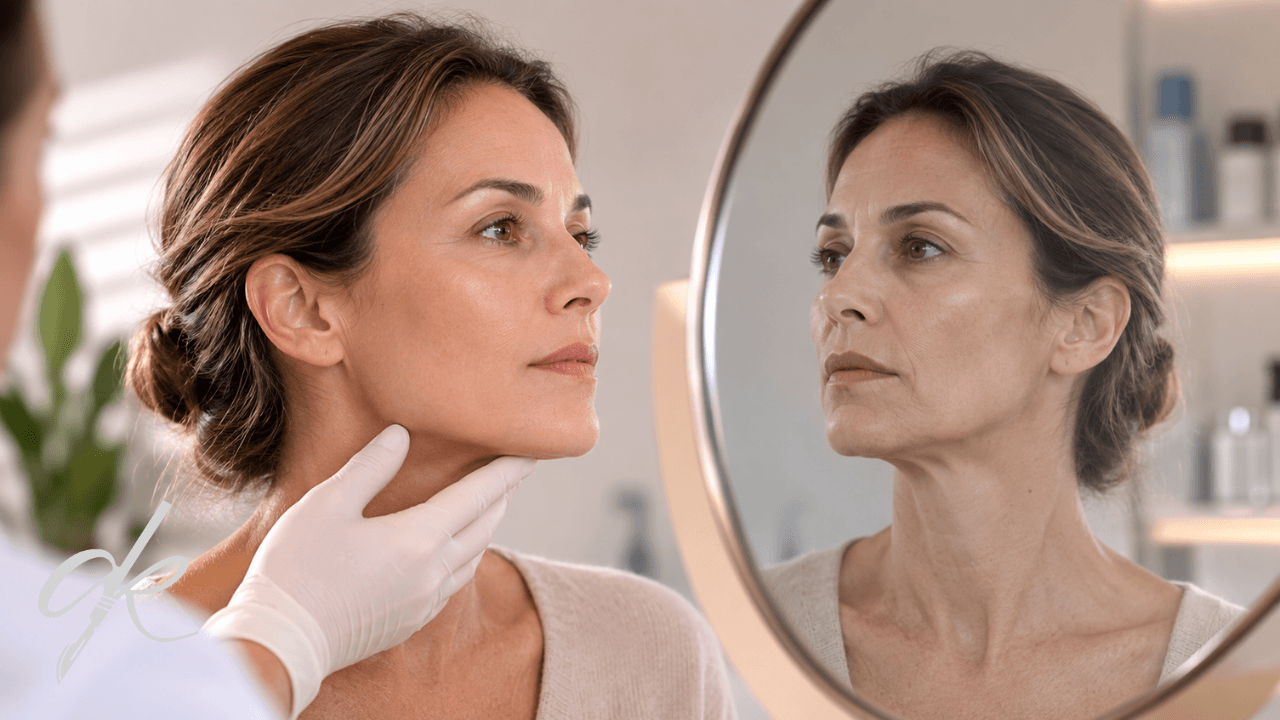
But the complaint is real and it has an anatomical basis. Facial fullness is one of the core components of a youthful appearance. When that fullness disappears quickly, the resulting face does not read as slimmer. It reads as hollow.
This article explains what is actually happening, how the options compare, and when surgery rather than volume becomes the answer.
Is “Ozempic face” a real condition?
First, the term itself.
“Ozempic face” does not appear in the medical literature as a diagnosis. In a publication by the American Society of Plastic Surgeons, surgeons state this plainly: it is a lay term describing facial deflation after rapid weight loss.
The second and more important point: the change is not specific to the medication. As noted in the same publication, these changes are not necessarily different from those seen in normal ageing — they simply occur much faster.
Instead of gradual volume loss over years, patients may see noticeable hollowing within a few months. Facial tissue is given no time to adapt or recoil.
The same picture therefore appears in anyone losing weight at that pace — after bariatric surgery, or through aggressive dieting.
How common is it?
Here an honest answer is required: this question does not currently have one.
The figures circulating online describe increases in aesthetic clinic attendance. One provider survey reported a marked rise in GLP-1 patients presenting to aesthetic practices over two years, and facial plastic surgery bodies have reported consecutive years of growth in fat grafting volumes.
But these numbers describe a market and a referral pattern, not a clinical incidence. The proportion of GLP-1 patients who develop volume loss troubling enough to seek treatment remains unstudied.
What I see in practice is consistent with that: two patients on the same dose for the same duration can look quite different at six months.
What happens in the face? The fat compartments
Facial fat is not a single continuous layer. It sits in discrete compartments separated by connective tissue, arranged in superficial and deep planes.
In youth these compartments are full, with soft transitions between them, which is why the face reads as a continuous surface. When they lose volume, the boundaries between them become visible and the face takes on a segmented, hollowed appearance.
Rapid weight loss depletes both superficial and deep compartments, frequently accompanied by soft tissue descent and laxity. The regions most affected are:
- Temples — hollowing here is early and conspicuous
- Cheekbone region — loss of projection flattens the face
- Under-eye area — hollowing and a tired expression
- Cheeks — inward collapse
- Around the mouth — deepening nasolabial and marionette folds
- Jawline — loss of definition
The mechanism matters here: the face does not only descend, it also deflates. That distinction determines the treatment, because lifting a deflated face does not make it look full.
Why is it more pronounced in some people?
- Speed of weight loss. Tissue is given no time to adapt.
- Amount lost. The greater the total, the greater the facial consequence.
- Age. Past forty it compounds volume loss already underway.
- Starting facial structure. Those with naturally slim faces show it more readily.
- Skin quality. Skin with reduced elasticity cannot accommodate lost volume.
- Sun exposure and smoking. Both degrade skin quality and worsen the picture.
How do the options compare?
| Fillers | Fat transfer | |
|---|---|---|
| Procedure | Injection, non-surgical | Surgical; fat harvested from the body |
| Longevity | Temporary, requires repetition | Retained portion can be lasting |
| Reversibility | Possible with some types | Not reversible |
| Volume capacity | Limited | Suitable for larger areas |
| Recovery | Short | 1-2 weeks of social downtime |
| Affected by weight change | No | Yes; can increase with weight gain |
| When suitable | Can be used during ongoing weight loss | After weight has stabilised |
The final row is decisive. While weight loss continues the face keeps changing, so reversible and adjustable options make more sense during that phase.
Realistic expectations with fat transfer
The most misunderstood aspect of fat transfer is that not all of the transferred fat is permanent.
Retention rates in the face are generally reported in the 50-70% range in published series, with higher figures reported in weight-stable patients. These rates vary with harvesting technique, processing method and injection protocol.
In post-bariatric populations, published outcomes are described as mixed, with retention that can be unpredictable.
The practical implication: a second session may be needed, and that is not a failure. The first procedure prepares the recipient site; retention in subsequent sessions is often better.
The overlooked problem: limited donor sites
This point deserves separate emphasis, because it is rarely discussed and it directly affects planning.
Fat transfer requires harvesting fat from somewhere on the body. In patients who have lost significant weight on GLP-1 medication, available donor fat may be limited. The abdomen, thighs and flanks may hold considerably less than expected.
This does not make the procedure impossible, but it changes the plan. In some patients the volume available may not meet the target, and combined approaches then come into consideration.
This is among the first things assessed at examination, and no amount of online reading substitutes for it.
When is surgery needed?
There is a fundamental distinction here, and it needs to be drawn correctly.
If the problem is volume loss alone, adding volume solves it. Fillers or fat transfer may be sufficient.
If significant skin laxity accompanies the volume loss, adding volume will not be enough. Loading more volume onto lax tissue makes a face look heavy rather than youthful.
Findings that bring surgery into consideration include:
- Marked loss of jawline definition
- Laxity in the neck
- Downward migration of the cheek
- Cheekbone fullness that has descended
- Insufficient improvement despite repeated filler treatments
That last point is common in practice: the patient has had filler several times, seen partial benefit each time, yet the core complaint persists. It usually signals that the problem is descent rather than volume.
Timing: when should treatment begin?
While weight loss is ongoing: too early for permanent volume, because the face keeps changing. Adjustable, reversible options and treatments supporting skin quality take priority during this phase.
After weight has stabilised: the general approach is at least six months without significant change. This matters particularly for fat transfer, since weight fluctuation affects both the donor site and graft retention.
The same waiting rule applies to the body; I have covered that in detail separately. Planning face and body together is worthwhile, particularly for donor site selection.
Planning treatment abroad
For patients travelling for treatment, two points deserve advance planning.
First, bring documentation of your weight over the past year. Weight stability is easier to demonstrate with figures than with description, and it directly determines what can be offered.
Second, if fat transfer is being considered, donor site availability cannot be assessed remotely with certainty. Photographs help, but the definitive assessment happens in person. Building flexibility into the plan — rather than arriving committed to one specific procedure — leads to better outcomes.
Can it be prevented?
- Managing the pace of weight loss. A conversation for the physician prescribing the medication.
- Adequate protein intake and resistance exercise. Reported to help limit lean tissue loss.
- Protecting skin quality. Sun protection and stopping smoking.
- Planning early. Assessing at the end of the weight loss process rather than the beginning avoids repeated, unnecessary treatments.
In summary
“Ozempic face” is not a medical diagnosis but a lay term for facial deflation after rapid weight loss. The change itself is no different from normal ageing — it simply happens over months instead of years.
Treatment choice rests on one question: is this volume loss alone, or is there skin laxity as well? In the first case adding volume works. In the second it does not, and repositioning the tissue comes into consideration.
If fat transfer is being considered, two realities should be understood from the outset: not all transferred fat is permanent, and donor fat may be limited after significant weight loss.
If you would like an assessment of which approach suits your own anatomy, you can arrange a consultation to discuss what is realistic in your case.
Frequently Asked Questions
Is “Ozempic face” a medical condition?
No. It is not a diagnosis found in the medical literature but a lay term describing facial deflation after rapid weight loss. The changes are not different from normal ageing; they simply occur much faster.
Will facial volume loss resolve on its own?
Not unless weight is regained. What has been lost is volume from the facial fat compartments, and it does not return while weight remains stable. Treatment involves adding volume or repositioning tissue.
Fillers or fat transfer — which is better?
It depends. While weight loss is ongoing, adjustable and reversible options make more sense. Once weight has stabilised and larger volume is needed, fat transfer comes into consideration. The decision follows examination.
How much transferred fat is permanent?
Retention in the face is generally reported in the 50-70% range and varies with technique. A second session may be needed; this is a normal part of the process rather than a failure.
How long should I wait after weight loss?
For permanent volume procedures the general approach is at least six months of stable weight. Weight fluctuation affects both the donor site and how well the graft survives.
Might I not have enough fat for a transfer?
Yes, this is a genuine constraint. After significant weight loss on GLP-1 medication, available donor fat in the abdomen, thighs and flanks may be limited. This changes the plan and is assessed at examination.
I’ve had fillers but it didn’t help — why?
This usually indicates the problem is not volume loss alone. Where significant skin laxity is present, adding volume is insufficient and can make the face look heavy rather than restored.
Does this only happen with GLP-1 medications?
No. It occurs in anyone losing weight at that pace, including after bariatric surgery or aggressive dieting. The determining factors are the speed and amount of weight loss, not the medication itself.
Dr. Ahmet Kaplan — Specialist in Plastic, Reconstructive and Aesthetic Surgery. A graduate of Hacettepe University Faculty of Medicine, he obtained his specialist title in 2020 and passed the European Board of Plastic, Reconstructive and Aesthetic Surgery (EBOPRAS) examination in 2022. Based in Istanbul. About Dr. Kaplan
This content is for informational purposes only and does not replace medical examination, diagnosis or treatment. Results vary between individuals. Do not make changes to your medication without consulting your physician.
References
- American Society of Plastic Surgeons. Beyond filler: How fat grafting restores the face after GLP-1 weight loss, 2026.
- ASDS Provider Survey on GLP-1 Patients in Aesthetic Practice, 2025.
- American Academy of Facial Plastic and Reconstructive Surgery, Annual Survey 2025.