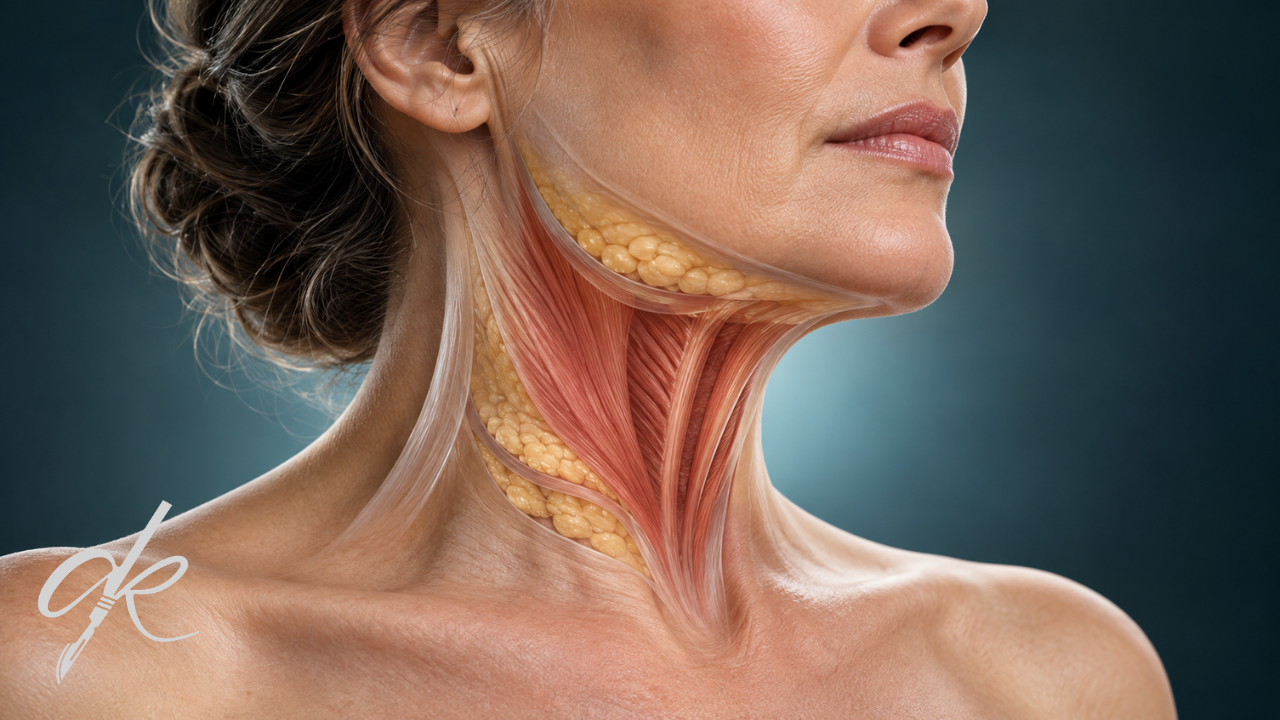

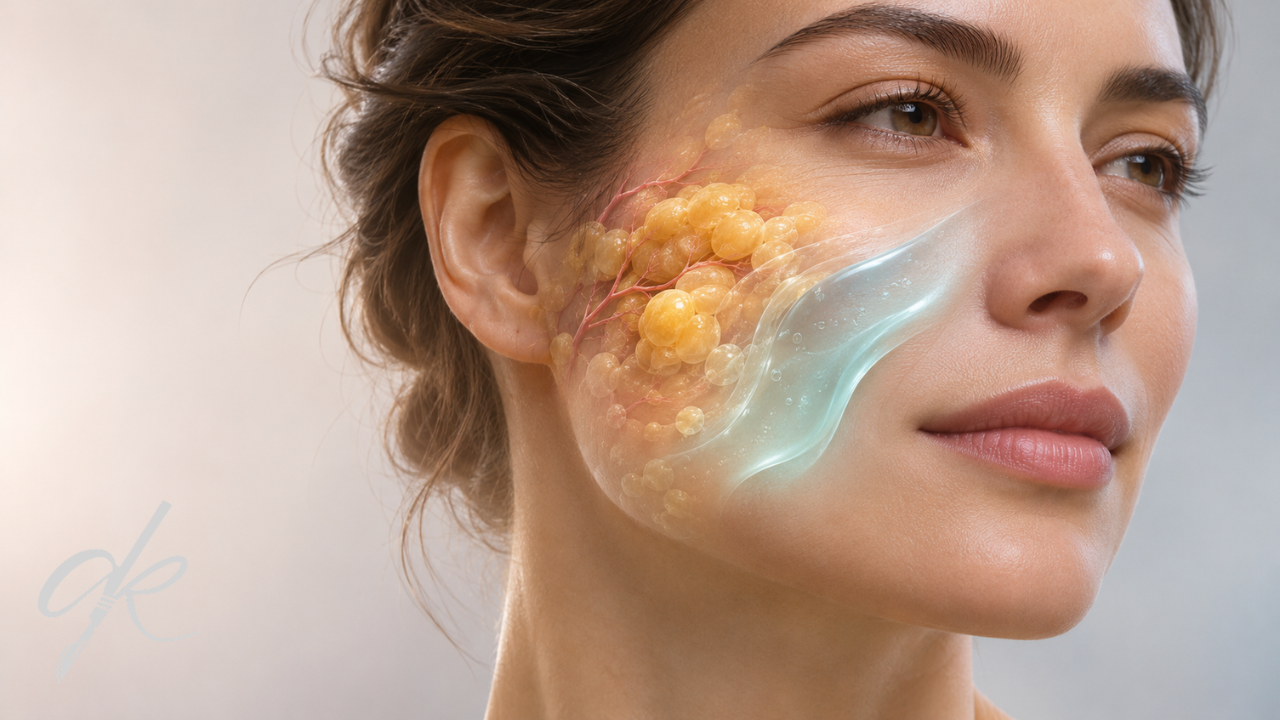
“Isn’t my own fat more natural?” is a question that contains two different things. The tissue used in fat transfer genuinely is your own — but how much of it survives cannot be predicted. In a meta-analysis of 27 studies and 1,011 patients, pooled volume retention was 47%, with individual studies ranging from 26% to 83%. Fillers are the opposite: a foreign material, but a predictable volume.
Most people arrive at this decision with one assumption already formed:
“Fillers are synthetic. My own fat must be the better choice.”
The first half of that sentence is correct. The second half depends entirely on what “better” means to you — and that is what this article separates.
“Natural” means two different things
This distinction drives the whole decision.
| “Natural” in what sense? | Fat transfer | Filler |
|---|---|---|
| As tissue — does it belong to your body? | ✅ Your own tissue | ❌ An introduced material |
| As a result — is the volume predictable? | ❌ Not predictable | ✅ The injected volume stays |
The two work in opposite directions.
There is a trade-off between biological naturalness and volumetric predictability — and the choice depends on how you weigh it.
The number: 47% on average, 26-83% across studies
The meta-analysis
A systematic review and meta-analysis covering 27 studies and 1,011 patients assessed volume retention after facial fat grafting.
| Measure | Result |
|---|---|
| Pooled retention | 47% (95% CI 41-53) |
| Range across studies | 26% – 83% |
| Mean follow-up | 3-24 months |
| Complication rate | 2.8% |
Put plainly: on average, roughly half of the transferred fat stays and half does not.
But the more useful information is not the average — it is the spread: 26% to 83%.
⚠️ And the authors’ own conclusion
The exact percentage of retained facial fat is currently unpredictable, and reported rates vary with the estimation method used.
That second clause matters: the review found that the volume measurement method significantly affected the reported rate.
So part of the gap between 26% and 83% is not biological variation at all — it is methodological noise.
Which leads to a practical consequence: any retention percentage you are quoted is an estimate, and the reliability of that estimate is limited.
One encouraging finding
The same review reported that secondary (repeat) grafting and patients with congenital deformities trended toward better retention.
The first group matters in practice: the portion that survived a first session may provide a better bed for a subsequent one.
Why is it so variable?
Transferred fat has to survive
Filler sits where it is placed as a gel; it has no biological needs.
Transferred fat is made of living cells and must be supplied with blood in its new location. New vessels have to grow in from the surrounding tissue. Cells for which this does not happen are lost.
What reduces retention
| Factor | Mechanism |
|---|---|
| Poor vascularisation | Supply fails, necrosis follows |
| Muscle movement | Graft settling is harder in a mobile area |
| High-pressure injection | Limits oxygen and nutrient diffusion, impairs new vessel formation |
| Over-injection | Same mechanism — necrosis, lost retention and oil cysts |
The last two rows carry a counterintuitive message: more fat does not mean more retention. Past a certain point, it increases loss.
And a practice worth knowing about
Sources note that surgeons frequently add around 30% extra fat to offset expected atrophy.
What that means for you: the volume you see immediately after surgery is not the final volume. Looking fuller than intended in the first weeks is expected.
Why a second session may be needed
The answer follows directly from the numbers above.
If pooled retention is 47% with a range of 26-83%, then the same quantity of fat in two people can produce visibly different results — and because that difference cannot be predicted, there is no guarantee of reaching the target volume in a single session.
Three possible outcomes
- Retention better than expected: one session may be enough
- Moderate retention: a top-up session may be considered
- Low retention: a more substantial additional session may be needed
When is this assessed?
The final result settles over roughly 3-6 months. A second-session decision is not made before that, because early volume includes both swelling and the deliberately over-placed amount.
The most honest framing is this: fat transfer should be planned not as a one-off procedure but as a process whose result is judged several months later.
Which areas hold better?
The mechanism answers this: areas with good blood supply and little movement retain better.
| Area characteristic | Retention expectation |
|---|---|
| Well vascularised, little movement, adequate recipient bed | Better |
| Poorly vascularised or highly mobile | Lower |
| Very thin overlying skin | Higher risk of visible irregularity |
The temple as a worked example
A review specific to temporal augmentation reported retention between 33% and 65.7%.
The authors attributed this variability partly to the relatively avascular temporal compartments and partly to temporalis muscle movement.
The example makes the general principle concrete: the same technique gives a different result in a different area, and the reason is anatomical.
The skin thickness question
Where skin is very thin, the risk of irregularity and visibility rises independently of the retention rate. Even an appropriately sized graft can show small contour irregularities through thin skin.
So area selection is not only “how much will stay” but also “how will the part that does not stay look”.
Note: Which areas are appropriate in your case depends on your skin thickness, existing volume status and your goal. That requires examination.
Compared with fillers
| Hyaluronic acid filler | Fat transfer | |
|---|---|---|
| Longevity | Typically 6-18 months; shorter in lips and around the mouth | The surviving portion is long-term; a share resorbs in the first months |
| Volume predictability | High — what is injected remains until the material breaks down | Moderate — under- or over-correction and asymmetry are possible |
| Reversibility | Dissolvable with hyaluronidase | Not dissolvable |
| Weight change | Unaffected | Can enlarge or shrink with weight |
| Procedure | Injection | Harvest + processing + injection |
| Recovery | Redness, swelling and bruising usually settle within days | Face swollen 1-2 weeks; socially comfortable at 2-3 weeks; final result 3-6 months |
| Donor site | Not required | A suitable donor site is required; bruising can last weeks |
| Best suited to | Limited volume deficits, precise point corrections | Widespread volume loss across several areas; combined with a procedure such as a facelift |
Risk profiles
Fillers: alongside the usual short-term effects, delayed nodules, infection and rare vascular occlusion — which can cause skin loss or vision loss.
Fat transfer: anaesthetic and surgical risks, donor-site complications, lumps and oil cysts, asymmetry, and rare vascular injury and fat embolism.
The word “rare” in both lists describes serious outcomes. Neither should be treated lightly.
🔴 Reversibility: the most overlooked difference
| If you are unhappy with the result | |
|---|---|
| HA filler | Can be dissolved with hyaluronidase |
| Fat transfer | Cannot be dissolved. Reducing volume requires liposuction, surgical excision or injections — each a separate procedure |
Note: Non-hyaluronic fillers — calcium hydroxylapatite, poly-L-lactic acid — are also not dissolvable. The reversibility advantage belongs specifically to HA, not to fillers in general.
What follows from this
The assessment in the sources is that because HA filler is the most adjustable option available, it carries the least irreversibility risk for a first volume treatment.
This does not mean fat transfer is inferior. It means sequence matters.
If you have never tested whether added facial volume suits you, seeing it with a reversible method can be a sensible first step.
Surviving fat behaves like fat
This is the most concrete consequence of “it’s my own tissue” — and it is almost never discussed.
Filler is a gel; body weight does not affect it.
Transferred fat is living adipose tissue and can enlarge or shrink with weight changes — sometimes disproportionately.
Two groups should weigh this heavily:
- People whose weight fluctuates. The result may not be stable. Sources note filler may suit this group better, precisely because gel is unaffected.
- People planning weight loss. Deferring until weight has settled gives a more predictable result.
Who is it not suitable for?
- Those without a suitable donor site. Very lean people may not yield enough fat.
- Those whose weight fluctuates.
- Those who have never tested added volume. A reversible method may be a better starting point.
- Those who cannot allow recovery time. 1-2 weeks of swelling, 2-3 weeks to social comfort and a 3-6 month settling period is a real commitment.
- Those expecting a definitive single-session result.
- During pregnancy and breastfeeding. Sources note both procedures are deferred.
- Active skin infection at the treatment site.
Smoking, uncontrolled diabetes, bleeding disorders and certain medications are noted as weighing more heavily against fat grafting.
Smoking carries particular weight: retention depends on new vessel formation, so anything affecting vascular behaviour bears directly on the result.
Worth discussing at consultation
- Is my goal widespread volume loss or a point correction?
- Which areas would be treated, and what is the retention expectation there?
- Is my skin thick enough in those areas?
- Do I have a suitable donor site?
- How many sessions are anticipated, and when would a second-session decision be made?
- How much fuller will I look in the first months?
- Does a planned weight change affect timing?
- What are my options if I am unhappy with the result?
- Would trying filler first make sense for me?
Summary
The answer to “isn’t my own fat more natural?” depends on what “natural” means. As tissue, yes. As a result, no — the volume is not predictable. Fillers are the reverse: an introduced material with a predictable volume. The choice is made across that trade-off.
The number: pooled retention 47% (95% CI 41-53) across 27 studies and 1,011 patients, range 26-83%, complication rate 2.8%. The authors’ conclusion is explicit — the exact percentage is unpredictable, and reported rates vary with the measurement method.
The need for a second session comes from that variability. Because the final result settles over 3-6 months, the decision is not made before then. Surgeons are noted to add around 30% extra fat to offset expected loss — so looking fuller in the first weeks is expected.
Anatomy explains the area differences: well vascularised, less mobile areas retain better. In the temple, reported retention ranges 33-65.7%, attributed to relatively avascular compartments and temporalis movement. Thin skin additionally raises irregularity risk.
And the most overlooked difference is reversibility. HA filler dissolves with hyaluronidase; fat does not. Surviving fat is also living adipose tissue and can change with your weight.
Which approach suits your situation can be determined by assessing your goal, skin thickness, donor site and weight status together. If you would like this assessed for your own case, you are welcome to arrange a consultation.
Frequently Asked Questions
How much of the fat is permanent?
In a meta-analysis of 27 studies and 1,011 patients, pooled retention was 47% (95% CI 41-53), with individual studies ranging from 26% to 83%. The authors state that the exact percentage is currently unpredictable and that reported rates vary with the measurement method used.
Is my own fat more natural than filler?
As tissue, yes. But in terms of outcome, filler is more predictable: the injected volume remains until the material breaks down. With fat transfer, how much survives cannot be predicted. There is a trade-off between biological naturalness and volumetric predictability.
Why might a second session be needed?
Because retention is unpredictable, there is no guarantee of reaching the target volume in one session. With a pooled rate of 47% and a 26-83% range, the same quantity of fat can give different results. The decision is not made before the final result settles at 3-6 months.
Will I look very full after surgery?
Sources note that surgeons frequently add around 30% extra fat to offset expected loss. With swelling added, looking fuller than intended in the first weeks is expected. Final volume settles over 3-6 months.
Which areas give better results?
Areas with good blood supply and little movement retain better. A review of temporal augmentation reported 33-65.7% retention, attributed to the relatively avascular temporal compartments and temporalis muscle movement. Where skin is very thin, irregularity risk rises.
Does injecting more fat mean more survives?
No. High-pressure and over-injection are reported to limit oxygen and nutrient diffusion, impair new vessel formation, and lead to necrosis, reduced retention and oil cysts.
Can it be reversed if I am unhappy?
Fat cannot be dissolved. Reducing volume requires liposuction, surgical excision or injections, each a separate procedure. Hyaluronic acid filler can be dissolved with hyaluronidase. Non-hyaluronic fillers are also not dissolvable.
Will my result change if I gain or lose weight?
It can. Transferred fat is living adipose tissue and can enlarge or shrink with weight changes, sometimes disproportionately. Filler is a gel and is unaffected by body weight, which is why sources note it may suit people whose weight fluctuates.
How long is recovery?
Sources report the face is swollen for roughly 1-2 weeks, social comfort returns around 2-3 weeks, and the final result settles over 3-6 months. Donor-site bruising can last weeks. With fillers, redness, swelling and bruising usually settle within days.
What are the risks?
For fat transfer: anaesthetic and surgical risks, donor-site complications, lumps and oil cysts, asymmetry, and rare vascular injury and fat embolism. The meta-analysis reported a 2.8% complication rate. For fillers: delayed nodules, infection and rare vascular occlusion, which can cause skin or vision loss.
If this is my first volume treatment, which should I start with?
The assessment in the sources is that HA filler is the most adjustable option available and therefore carries the least irreversibility risk for a first volume treatment. This does not make fat transfer inferior — it means sequence can matter if you have never tested whether added volume suits you.
Op. Dr. Ahmet Kaplan — Specialist in Plastic, Reconstructive and Aesthetic Surgery.
This content is for information only, does not constitute medical advice and does not replace examination by a physician. The rates cited are pooled results from published studies and carry the variability and measurement limitations described in the text; individual results vary with anatomy, tissue characteristics, technique and clinical circumstances.