
One of the most important questions patients ask before breast augmentation surgery is where the implant should be placed. “Does under-the-muscle placement look more natural?”, “Is over-the-muscle placement easier to recover from?”, “Will the implant be visible in slim patients?”, “What exactly does dual plane mean?” These are common and very reasonable questions during breast augmentation planning.
Implant placement is not just a technical detail. It can affect the final breast shape, upper breast transition, implant visibility, implant feel, recovery process, movement during exercise and the overall natural appearance. For this reason, deciding whether the implant should be placed over the muscle, under the muscle or in a dual plane position should always be personalized.
There is no single “best” technique for every patient. In some patients, over-the-muscle placement may be appropriate. In others, under-the-muscle or dual plane placement may offer certain advantages. Especially in slim patients, patients with limited natural breast tissue or patients with a higher risk of visible implant edges, under-the-muscle and dual plane techniques are often considered.
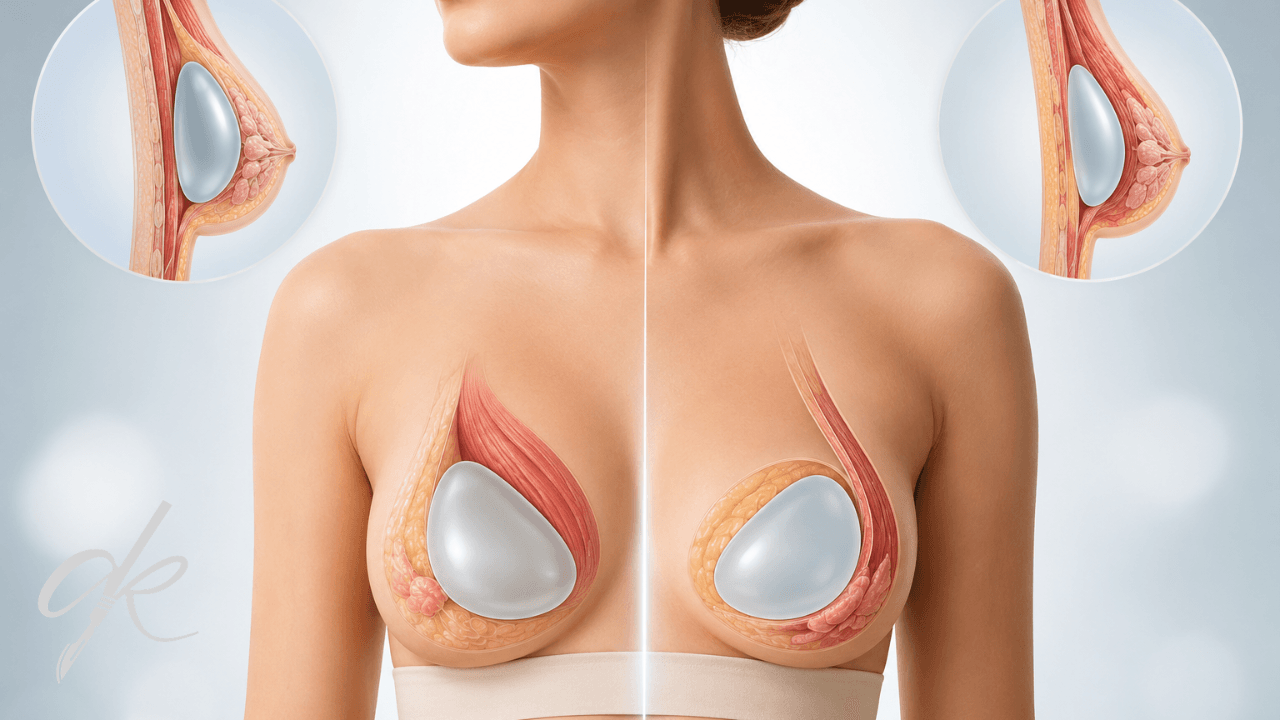
The dual plane technique can be described as a combined approach in which the upper part of the implant is covered by the pectoral muscle, while the lower part of the implant is positioned under the breast tissue. This technique aims to combine some of the advantages of both under-the-muscle and over-the-muscle placement. It may provide better coverage in the upper breast while allowing the lower breast to form a more natural slope.
However, dual plane breast augmentation is not mandatory for every patient. The most suitable technique depends on breast tissue thickness, skin elasticity, chest wall structure, nipple position, degree of sagging, implant size, implant profile, lifestyle and personal expectations.
In this article, we will explain the differences between over-the-muscle, under-the-muscle and dual plane breast implant placement, how these techniques relate to natural-looking results, why under-the-muscle or dual plane approaches may be advantageous in slim patients, and what should be considered before surgery. This content is prepared in line with the expertise of Dr. Ahmet Kaplan, a Plastic, Reconstructive and Aesthetic Surgeon in Istanbul, Turkey.
Why Is Implant Placement Important in Breast Augmentation?
In breast augmentation surgery, implant selection is important, but implant placement is just as important. The position of the implant can influence breast shape, softness, upper pole fullness, lower breast curve, implant visibility and the overall perception of naturalness.
Breast implants can be placed in different anatomical planes depending on the patient’s breast tissue and chest muscle structure. The main options are:
Over the muscle, also known as subglandular placement
Under the muscle, also known as subpectoral or submuscular placement
Dual plane placement, where the upper part of the implant is under the muscle and the lower part is under the breast tissue
Each option has possible advantages and limitations. Therefore, the decision should not be based only on a patient saying, “I want under the muscle” or “I want over the muscle.” The surgeon’s examination, measurements and tissue assessment are essential.
For example, a patient with enough natural breast tissue, good skin quality and a desire for a moderate increase may be suitable for over-the-muscle placement. On the other hand, a slim patient with thin tissue and a higher risk of visible implant edges may benefit more from under-the-muscle or dual plane placement.
What Is Over-the-Muscle Breast Implant Placement?
Over-the-muscle breast implant placement means that the implant is placed above the pectoral muscle and beneath the breast tissue. Medically, this is known as subglandular placement.
This technique may offer certain advantages in suitable patients. Since the chest muscle is less affected, recovery may feel more comfortable in some cases. The implant is also less influenced by chest muscle movement. In patients with sufficient natural breast tissue, over-the-muscle placement can provide a soft and natural-feeling result.
However, over-the-muscle placement is not suitable for every patient. In slim patients, patients with thin tissue or patients with limited natural breast volume, implant edges may become more visible or palpable. Rippling or a more artificial upper pole fullness may also be more noticeable in some cases.
The suitability of over-the-muscle placement depends strongly on how well the patient’s breast tissue can cover the implant. If there is not enough tissue coverage, the implant may be easier to see or feel.
What Is Under-the-Muscle Breast Implant Placement?
Under-the-muscle breast implant placement means that the implant is placed beneath the pectoral muscle. However, in daily language, “under the muscle” may sound like the entire implant is completely covered by muscle. In reality, the pectoralis major muscle does not cover the entire lower breast area. Therefore, the implant is often partially covered by muscle in the upper part, while the lower and outer parts have a different tissue relationship.
One of the main advantages of under-the-muscle placement is that it provides more tissue coverage over the upper part of the implant. This can be especially important in slim patients, patients with limited breast tissue or those at higher risk of visible implant edges.
Under-the-muscle placement may create a softer transition in the upper breast area. This can help reduce the appearance of a sharp implant edge and support a more natural upper breast contour.
However, recovery after under-the-muscle placement may be more sensitive in some patients compared with over-the-muscle placement. Since the chest muscle is involved, patients may experience more pressure, tightness, discomfort and temporary limitations in arm movement during the early recovery period.
In patients who perform intense chest muscle exercises, implant movement related to muscle contraction, known as animation deformity, may also be discussed.
What Is the Dual Plane Technique?
The dual plane technique is a breast augmentation approach in which the upper part of the implant is placed under the pectoral muscle, while the lower part of the implant is positioned under the breast tissue. It can be understood as a combined plane technique.
This technique aims to combine some advantages of under-the-muscle and over-the-muscle placement. In the upper breast area, muscle coverage may help hide the implant edge. In the lower breast area, the breast tissue can spread more naturally over the implant and support a more natural lower pole shape.
In dual plane placement, the upper portion of the implant is covered by the muscle. This may help reduce a sharp or artificial-looking upper breast outline. The lower portion allows the implant to interact more naturally with the breast tissue, helping to create a more natural breast slope.
Dual plane technique may be considered in patients with limited breast tissue, mild lower breast looseness, a desire for a natural upper transition or a higher risk of implant visibility in the upper breast area.
However, the dual plane technique is not a standard method applied in the same way to every patient. The surgeon personalizes the plan according to breast tissue thickness, nipple position, skin elasticity, breast fold location, implant size and overall chest anatomy.
Why Is the Dual Plane Technique Associated with a Natural Appearance?
One of the key features of a natural-looking breast is a soft transition from the upper chest to the lower breast. A very round, sharp or overly full upper pole can sometimes create an artificial appearance.
The dual plane technique aims to provide more tissue coverage over the upper part of the implant by placing it under the pectoral muscle. This may help make the upper implant edge less visible. In the lower part, the breast tissue can spread over the implant more naturally, supporting a softer lower pole shape.
This can be particularly useful in slim patients. When there is not enough natural tissue in the upper breast area, the implant outline may become easier to see. Dual plane placement can help create a smoother transition by adding muscle coverage over the upper implant.
However, natural appearance does not depend only on implant placement. Implant volume, base width, profile, shape, breast tissue thickness, chest wall structure and surgical planning all influence the final result.
If an implant is too large for the patient’s tissue capacity, the result may look less natural regardless of the technique used. Therefore, the dual plane technique can support a natural appearance in suitable patients, but it does not guarantee a natural result by itself.
Why May Under-the-Muscle or Dual Plane Placement Be Advantageous in Slim Patients?
Slim patients often have less breast tissue and less subcutaneous fat. This means there may be less natural tissue covering the implant. When tissue coverage is limited, implant edges may be easier to see, rippling may be more noticeable and the upper breast transition may look sharper.
Under-the-muscle and dual plane techniques can be advantageous in slim patients because they provide additional coverage over the upper part of the implant. The pectoral muscle helps hide the implant edge and may create a softer upper breast slope.
Implant selection is also very important in slim patients. Implants that are too large or too wide for the patient’s chest can appear more obvious when tissue coverage is thin. The implant size should be selected according to chest measurements, breast base width and tissue capacity.
Although dual plane technique is often considered in slim patients, it is not automatically the best option for everyone. Exercise habits, muscle structure, nipple position, skin elasticity and personal expectations should all be evaluated.
What Are the Advantages of Over-the-Muscle Placement?
Over-the-muscle placement may offer certain advantages in suitable patients. Since the pectoral muscle is less affected, early recovery may feel easier for some patients. There may be less muscle-related pain or tightness compared with under-the-muscle techniques.
Because the implant is not placed beneath the muscle, it may also be less affected by chest muscle movement. This can be relevant for patients who heavily use their pectoral muscles, such as certain athletes or fitness-focused individuals.
In patients with enough breast tissue, over-the-muscle placement can provide a soft and natural breast movement. However, this requires enough tissue coverage over the implant.
The main limitation of over-the-muscle placement is the risk of implant visibility or palpability in thin-tissue patients. For this reason, it is generally more suitable when breast tissue thickness and skin quality provide adequate coverage.
What Are the Advantages of Under-the-Muscle Placement?
Under-the-muscle placement may be advantageous because it gives extra coverage over the upper part of the implant. This can be especially helpful in patients with thin tissue.
It may reduce the visibility of the upper implant edge and support a softer upper breast contour. In patients with limited natural breast tissue, this additional coverage can be important.
Because the implant is placed in a deeper plane, some patients may also feel that the implant is better protected or less visible. However, the benefits depend on each patient’s anatomy.
Under-the-muscle placement may also be discussed in relation to breast imaging, but mammography and screening should always be evaluated individually according to the patient’s age, risk factors, implant type and radiology team recommendations.
The main consideration is recovery. Under-the-muscle placement may involve more tightness, discomfort and muscle-related sensitivity in the early days. Return to exercise, heavy lifting and intense chest activity should be planned carefully.
What Are the Advantages of the Dual Plane Technique?
The most important advantage of the dual plane technique is that it provides muscle coverage over the upper implant while allowing a more natural relationship between the implant and the lower breast tissue.
This makes it a useful option in selected patients who want a softer upper transition, a natural-looking breast slope and better implant coverage in the upper pole.
In the upper breast, the implant is better hidden by the muscle. In the lower breast, the implant can help create a more natural lower pole shape by interacting with the breast tissue.
Dual plane technique may also be useful in some patients with mild breast looseness. However, if there is significant breast sagging, dual plane placement alone may not be enough. A breast lift may need to be considered.
When planned correctly, the dual plane technique may support natural transitions. However, if implant size, tissue quality and breast anatomy are not evaluated properly, the desired outcome may not be achieved.
Are There Any Limitations of the Dual Plane Technique?
Like every surgical technique, the dual plane technique has limitations. First, it requires detailed anatomical planning. The relationship between muscle and breast tissue must be managed carefully.
During recovery, patients may experience tightness, pressure and movement sensitivity similar to under-the-muscle placement. Chest muscle activity may need to be limited for a period of time.
In some patients, the implant may move slightly during chest muscle contraction. This is not always noticeable, but it should be discussed in patients who perform intense pectoral exercises.
Another important point is that dual plane placement does not correct significant sagging by itself. If the nipple is positioned low or there is significant excess skin, implant placement alone may not be enough. In such cases, breast lift surgery may be considered together with implant placement.
Where Should the Implant Be Placed for a Natural Look?
The most natural-looking implant placement depends on the patient. In slim patients with limited upper breast tissue, under-the-muscle or dual plane placement may create a softer upper transition.
In patients with enough breast tissue and good skin quality, over-the-muscle placement may also look natural. Therefore, it is not correct to say that “only under-the-muscle looks natural” or “over-the-muscle always looks artificial.”
The main factors that influence natural appearance are implant size, implant base width, implant profile, chest wall measurements, breast tissue thickness, nipple position, skin elasticity and surgical planning.
A moderate implant may look very natural over the muscle in one patient, but the same implant may be visible in another patient with thin tissue. This is why planning should always be personalized.
Does Implant Size Affect the Placement Plan?
Yes. Implant size and base width can directly affect placement planning. Very large implants may increase the risk of visible implant edges, skin stretching, artificial upper fullness or long-term tissue strain, especially in thin patients.
Under-the-muscle and dual plane techniques may provide more coverage over the upper part of the implant, but they do not completely eliminate the problems that may occur with an implant that is too large for the patient’s tissue capacity.
For patients who want a natural appearance, implant selection should not be based only on “how many cc.” Chest width, breast base, skin elasticity, existing breast volume and lifestyle should all be evaluated.
A larger implant does not always mean a better aesthetic result. In many cases, a moderate implant that matches the patient’s proportions can create a more natural and comfortable long-term outcome.
How Is Breast Tissue Thickness Evaluated?
Before breast augmentation surgery, the surgeon evaluates breast tissue thickness and the tissue’s ability to cover the implant. This can be assessed during physical examination, and in some patients, measurements or imaging may also be considered.
If there is not enough tissue in the upper breast area, implant edges may become more visible with over-the-muscle placement. In such cases, under-the-muscle or dual plane placement may be discussed.
If the patient has enough breast tissue, over-the-muscle placement may be one of the possible options. However, tissue thickness alone is not the only factor. Skin elasticity, nipple position, breast fold location, chest wall shape and implant selection are also important.
Implant placement should be planned according to the actual tissue coverage in the breast area, not only according to the patient’s body weight.
Is Dual Plane Enough If There Is Breast Sagging?
Breast sagging is an important factor in implant placement planning. In patients with mild looseness, dual plane placement may help the implant relate better to the breast tissue and support a more natural shape. However, if sagging is significant, implant placement alone may not be enough.
If the nipple is positioned low, breast tissue has descended or there is significant excess skin, a breast lift may be needed. In these cases, placing the implant under the muscle or using a dual plane technique does not fully correct sagging.
Some patients believe that an implant will lift the breast by itself. An implant can add volume, but it does not always correct significant sagging. The degree of sagging should be assessed during examination before deciding on the surgical plan.
Which Placement Is More Suitable for Athletic Patients?
Implant placement should be evaluated carefully in athletic patients. This is especially important for patients who frequently use the pectoral muscles, such as those involved in weight training, fitness, swimming, CrossFit or similar activities.
With under-the-muscle or dual plane placement, the implant is related to the chest muscle. When the muscle contracts, the implant may move or change shape slightly. This is known as animation deformity. It is not noticeable in every patient, but it should be discussed in patients with intense pectoral muscle activity.
With over-the-muscle placement, the implant is less affected by muscle movement. For this reason, over-the-muscle placement may be considered in some athletic patients. However, enough tissue coverage is required for this option.
In active patients, the decision should be based on tissue thickness, implant size, exercise intensity and natural appearance expectations.
Is Recovery Different Between Over-the-Muscle and Under-the-Muscle Placement?
Yes. Recovery may differ depending on implant placement.
With over-the-muscle placement, the chest muscle is less affected. Therefore, some patients may experience a more comfortable early recovery. Pain and arm movement limitations may be less noticeable.
With under-the-muscle and dual plane techniques, a pocket related to the pectoral muscle is created. Because of this, patients may feel more pressure, tightness or muscle sensitivity during the early days. Arm movement, lifting and exercise may require more careful planning.
However, recovery does not depend only on implant placement. Implant size, surgical technique, pain threshold, tissue structure, postoperative care and compliance with medical instructions also influence the recovery process.
It is not accurate to say “over-the-muscle always heals easily” or “under-the-muscle is always difficult.” Recovery varies from person to person.
Is Pain Greater After Under-the-Muscle or Dual Plane Placement?
Because under-the-muscle and dual plane techniques involve the pectoral muscle, early tightness and pressure may be more noticeable. Some patients may feel more discomfort compared with over-the-muscle placement.
However, with modern surgical techniques, appropriate pain management and a clear recovery plan, this process can usually be managed. Discomfort generally decreases over time, and patients gradually return to daily activities.
Pain level varies from person to person. Two patients who have the same technique may experience recovery differently. For this reason, realistic preoperative education is important.
When Are Implant Edges More Likely to Be Visible?
Implant edges are more likely to become visible when tissue coverage is limited. Slim patients, patients with thin breast tissue, patients with low subcutaneous fat and patients choosing overly large implants may have a higher risk.
With over-the-muscle placement, the implant is covered mainly by breast tissue and skin. If these tissues are thin, the implant may become more visible or more palpable. Under-the-muscle or dual plane techniques can help reduce this risk in the upper breast by adding muscle coverage.
However, implant edge visibility is not related only to placement. Implant type, size, profile, surface, skin quality and pocket planning are also important.
For patients who want a natural appearance, choosing an implant that matches the body structure is essential.
What Is Rippling and Is It Related to Implant Placement?
Rippling refers to visible or palpable folds or waves on the implant surface. It is more likely to occur when tissue coverage is thin.
With over-the-muscle placement, if there is not enough tissue covering the implant, rippling may become more noticeable. Under-the-muscle or dual plane placement may help reduce visibility in the upper part by providing additional coverage.
However, rippling is not caused only by implant placement. Implant type, implant filling, shape, size, tissue thickness and skin elasticity all play a role.
To reduce the risk of rippling, implant selection and implant placement should be planned together according to the patient’s anatomy.
Comparison of Over-the-Muscle, Under-the-Muscle and Dual Plane Placement
| Feature | Over the Muscle | Under the Muscle | Dual Plane |
|---|---|---|---|
| Implant position | Above the muscle, under breast tissue | Under or partially related to the muscle | Upper part under muscle, lower part under breast tissue |
| Natural upper transition | Can be good if tissue is sufficient | Can be advantageous in thin tissue | May support a softer upper transition |
| Coverage in slim patients | May be limited | Better upper coverage | Better upper coverage |
| Recovery comfort | May be easier in some patients | May feel more sensitive early on | Similar to under-the-muscle in some patients |
| Relation to exercise | Less affected by muscle movement | Muscle movement may affect implant | Muscle movement may affect implant |
| Mild sagging | Depends on the patient | Depends on the patient | May be useful in selected cases |
| Significant sagging | Usually not enough alone | Usually not enough alone | Breast lift may be needed |
This table is for general information only. The most suitable technique should be determined through personal examination.
Is the Dual Plane Technique Suitable for Everyone?
No. The dual plane technique is not automatically suitable for every patient. Suitability depends on breast tissue, skin quality, nipple position, degree of sagging, chest muscle structure, implant size and lifestyle.
In some patients, over-the-muscle placement may be more suitable. In others, under-the-muscle or dual plane placement may be more advantageous. Some patients may require implant placement together with a breast lift.
Patients should not focus only on the name of the technique. The more important question is which approach is most suitable for their own anatomy.
Is Technique Alone Enough for a Natural Result?
No. A natural-looking breast augmentation result does not depend only on whether the implant is placed over the muscle, under the muscle or in a dual plane position.
Implant volume, base width, profile, tissue thickness, chest wall shape, nipple position, breast fold location and skin elasticity all matter.
The patient’s expectation is also important. Some patients prefer a fuller and more noticeable result, while others want a subtle and natural enhancement. This expectation influences implant selection and placement planning.
The best plan is the one that brings the patient’s anatomy and expectations together within safe and realistic limits.
Personalized Breast Augmentation Planning with Dr. Ahmet Kaplan in Istanbul, Turkey
In breast augmentation surgery, deciding whether the implant should be placed under the muscle, over the muscle or in a dual plane position is a personalized decision. It should not be based only on trends or a general preference.
Dr. Ahmet Kaplan, a Plastic, Reconstructive and Aesthetic Surgeon in Istanbul, Turkey, evaluates breast tissue, skin quality, chest measurements, sagging degree, lifestyle and expectations together during breast augmentation planning.
In slim patients, under-the-muscle or dual plane placement may be considered to reduce implant visibility and support a softer upper transition. However, in some patients with enough breast tissue, over-the-muscle placement may also be an appropriate option.
The goal is not only to increase breast volume. The goal is to create a balanced, natural-looking and long-term comfortable plan that fits the patient’s body proportions.
Conclusion: Under the Muscle or Over the Muscle Should Be Decided Individually
In breast augmentation surgery, whether the implant should be placed under the muscle, over the muscle or in a dual plane position must be evaluated individually. There is no single technique that is best for everyone.
Over-the-muscle placement may be suitable for patients with enough breast tissue and good skin quality. Under-the-muscle placement may help hide the upper implant edge in slim and thin-tissue patients. Dual plane technique aims to combine the advantages of both approaches by providing muscle coverage in the upper part and allowing a more natural lower breast shape.
For a natural appearance, implant placement is important, but it is not the only factor. Implant size, tissue thickness, skin elasticity, chest wall structure and surgical planning all need to be considered together.
Patients considering breast augmentation in Istanbul, Turkey should not look for a single universal answer to “under the muscle or over the muscle?” Instead, they should seek a personalized evaluation to determine the most appropriate plan for their own anatomy and expectations.
Frequently Asked Questions
What does under-the-muscle breast augmentation mean?
Under-the-muscle breast augmentation means that the implant is placed beneath or partially beneath the pectoral muscle. It may provide better upper implant coverage in selected patients.
What is over-the-muscle breast implant placement?
Over-the-muscle placement means that the implant is placed above the chest muscle and under the breast tissue. It may be suitable for patients with enough natural breast tissue.
What is the dual plane technique?
The dual plane technique is a breast augmentation approach where the upper part of the implant is under the muscle and the lower part is under the breast tissue.
Does the dual plane technique create a natural look?
In suitable patients, it may support a softer upper breast transition and a more natural lower breast shape. However, natural appearance depends on personalized planning.
Which technique is better for slim patients?
In slim patients with thin breast tissue, under-the-muscle or dual plane techniques may offer better implant coverage. The final decision should be made after examination.
Does over-the-muscle placement always look artificial?
No. If the patient has enough breast tissue and the implant is chosen appropriately, over-the-muscle placement can look natural.
Is under-the-muscle placement more painful?
Under-the-muscle and dual plane placements may involve more muscle-related tightness or discomfort in the early days. Pain varies from person to person.
Is dual plane suitable for everyone?
No. Dual plane is not required for every patient. It should be evaluated according to breast tissue, skin quality, sagging degree and expectations.
Is dual plane enough if there is breast sagging?
It may help in selected mild cases, but significant sagging usually requires evaluation for a breast lift.
Can under-the-muscle implants be a problem for athletic patients?
In patients who heavily use the chest muscles, under-the-muscle or dual plane implants may move with muscle contraction. This should be discussed during planning.
Why do implant edges become visible?
Implant edges may become visible when tissue coverage is thin, the patient is very slim or the implant is too large for the body structure.
What is rippling?
Rippling means visible or palpable folds or waves on the implant surface. It is more common in patients with thin tissue coverage.
Can dual plane reduce rippling?
It may help reduce visibility in the upper breast by providing muscle coverage, but rippling depends on several factors, not placement alone.
Which implant placement gives the most natural result?
There is no single answer. The most natural placement depends on breast tissue thickness, skin quality, chest structure and implant selection.
Is implant size or implant placement more important?
Both are important. A natural and balanced result depends on implant size, implant profile, tissue thickness and placement plan together.
Instagram Caption:
In breast augmentation surgery, implant placement is one of the most important steps for achieving a natural-looking result.
Over-the-muscle placement may be considered in patients with enough breast tissue. Under-the-muscle placement may help provide better upper implant coverage, especially in slim patients with thin tissue.
The dual plane technique is a combined approach where the upper part of the implant is placed under the muscle, while the lower part is positioned under the breast tissue. This may support a softer upper transition and a more natural lower breast shape in suitable patients.
However, there is no single correct method for everyone. Breast tissue thickness, skin elasticity, chest structure, implant size, exercise habits and personal expectations should all be evaluated together.
A natural result depends not only on the technique, but also on personalized planning.
For patients considering breast augmentation in Istanbul, Turkey, the most appropriate implant placement should be determined through an individual surgical evaluation.
ℹ️ Results may vary from person to person in every surgical or interventional procedure. It is recommended to consult your physician for detailed information before the procedure.