
Liposuction is one of the surgical procedures used to reduce localized fat deposits and support a more balanced body contour in suitable patients. However, when we talk about liposuction, we are not referring to only one single technique. Traditional liposuction, power-assisted liposuction, laser-assisted liposuction and ultrasound-assisted liposuction are among the different methods that may be used depending on the patient and the surgical plan.
One of the most commonly discussed techniques today is VASER liposuction.
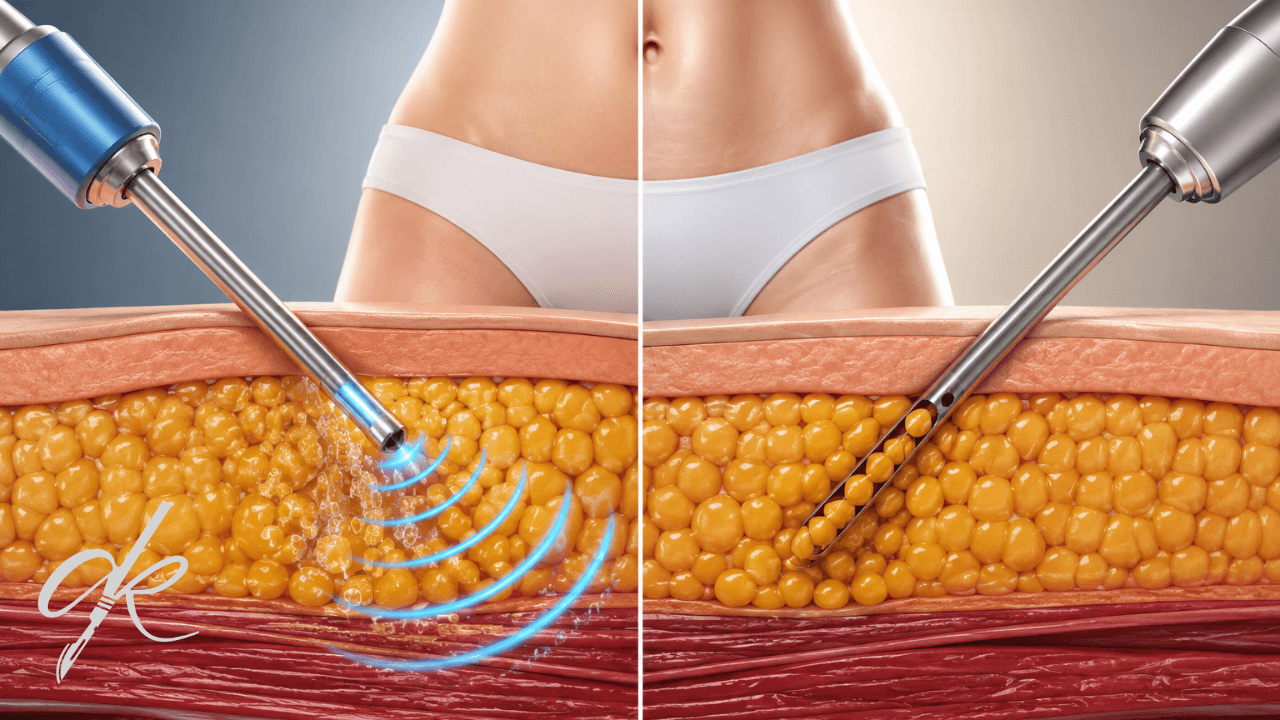
VASER liposuction is an ultrasound-assisted liposuction technique that uses ultrasonic energy to help separate fat tissue from surrounding structures before it is removed. In traditional liposuction, fat tissue is usually broken down mechanically with cannula movements and then removed with suction. In VASER liposuction, ultrasound energy is first used to loosen and emulsify the fat tissue, and then the fat is aspirated.
Because of this difference, patients often ask: “Is VASER liposuction better than traditional liposuction?”, “Does it cause less bruising?”, “Can it tighten the skin?”, “Is it suitable for everyone?”, “Can it help me lose weight?”
The answers depend on the patient’s body structure, skin quality, fat tissue characteristics, treatment area, expectations and the surgeon’s planning. VASER liposuction may provide certain advantages in selected patients, especially when more precise contouring or treatment of firmer fat tissue is needed. However, it is still a surgical procedure and should not be considered a guaranteed, risk-free or weight loss method.
In this article, we will explain the differences between VASER liposuction and traditional liposuction, how ultrasonic sound waves affect fat tissue, what patients should realistically expect regarding bruising, swelling and skin tightening, and how suitability is evaluated. This content is prepared in line with the expertise of Dr. Ahmet Kaplan, a Plastic, Reconstructive and Aesthetic Surgeon in Istanbul, Turkey.
What Is Liposuction?
Liposuction is a surgical procedure that reduces subcutaneous fat tissue in specific areas of the body. Although it is commonly known as “fat removal,” its main purpose is not weight loss. Liposuction is better understood as a body contouring procedure.
Areas such as the abdomen, waist, hips, back, inner and outer thighs, arms, inner knees, male chest area and under the chin may be evaluated for liposuction. However, not every type of fullness is suitable for liposuction.
Loose skin, muscle structure, deeper internal fat around the organs and overall body weight should be evaluated separately. For example, abdominal fullness may sometimes be related more to loose skin or internal fat than to removable subcutaneous fat.
The goal of liposuction is not to remove the largest possible amount of fat. The goal is to create a safe, balanced and natural-looking contour that fits the patient’s body proportions. For this reason, the technique should not be chosen only because it is popular. It should be selected according to the patient’s needs, tissue quality and surgical goals.
What Is Traditional Liposuction?
Traditional liposuction is based on mechanically breaking down fat tissue with thin cannulas and removing it through suction. During the procedure, the surgeon moves the cannula in a controlled manner within the fat layer under the skin. The fat tissue is loosened through this mechanical movement and removed with vacuum assistance.
Traditional liposuction has been used for many years and can be effective in suitable patients when performed with proper planning and surgical experience. However, depending on tissue structure, treatment area and the amount of fat to be removed, more physical effort may be required during the procedure.
Some areas contain firmer or more fibrous fat. The back, male chest area, waist region and previously treated areas may have more resistant fat tissue. In these areas, traditional liposuction may require more mechanical movement.
This mechanical work may contribute to bruising, swelling, tenderness or firmness during recovery in some patients. However, these effects vary from person to person. Surgical technique, patient characteristics and the extent of the procedure all influence the recovery experience.
What Is VASER Liposuction?
VASER liposuction is a type of ultrasound-assisted liposuction. The technique uses ultrasonic energy to help separate fat tissue more selectively before it is removed from the body.
In many cases, a special fluid is first introduced into the treatment area. Then, ultrasound energy is delivered through thin probes. This energy helps loosen the bonds between fat cells and makes the fat easier to remove. In the final stage, the loosened fat is removed with suction cannulas.
The main difference between VASER liposuction and traditional liposuction is that VASER uses ultrasound energy before fat aspiration. Instead of relying only on mechanical disruption, it prepares the fat tissue in a more controlled way.
This may allow the surgeon to work more precisely in certain areas, especially where fat is firmer or where fine contouring is desired. However, VASER liposuction is still surgery. The fact that a device is technologically advanced does not mean the procedure is free of risk.
Surgeon experience, patient selection, energy settings, treatment duration, anatomical knowledge and postoperative care are just as important as the technology itself.
What Is the Main Difference Between VASER Liposuction and Traditional Liposuction?
The main difference lies in how the fat tissue is prepared before removal.
In traditional liposuction, fat is usually broken down mechanically with cannula movements and then removed through suction. In VASER liposuction, fat tissue is first loosened with ultrasonic sound waves and then aspirated.
This difference may be important in areas with firmer or more fibrous fat. Ultrasonic energy can help separate fat tissue from surrounding connective structures in a more controlled manner. This may make it easier to work in certain anatomical areas.
However, this does not mean that VASER liposuction is automatically better for every patient. In some cases, traditional liposuction may be sufficient and appropriate. In others, VASER-assisted liposuction may offer certain practical advantages.
The correct decision depends on body structure, skin elasticity, fat quality, treatment area and surgical goals.
How Do Ultrasonic Sound Waves Affect Fat Tissue?
In VASER liposuction, ultrasonic energy creates a vibration effect within the fat tissue. This energy helps loosen the connections between fat cells and turns the fat into a softer, more easily removable form.
Patients sometimes hear the phrase “the fat is melted.” A more accurate description is that the fat is emulsified or separated with ultrasound energy before being removed by suction.
The selective nature of ultrasonic energy may help protect surrounding structures such as blood vessels, nerves and connective tissue more carefully in some patients. This is why VASER liposuction is often associated with the possibility of less tissue trauma, less bruising or a more comfortable recovery.
However, these possible benefits vary from patient to patient. The treated area, surgical technique, duration of the procedure, amount of energy used, tissue characteristics and postoperative care all affect the recovery process.
Does VASER Liposuction Cause Less Bruising?
One of the commonly mentioned potential advantages of VASER liposuction is that it may cause less bruising in some patients compared with traditional liposuction. This is related to the way ultrasound energy helps loosen fat tissue before aspiration.
In traditional liposuction, more mechanical movement may be needed to break down the fat tissue. This can create more mechanical impact on surrounding tissues in certain cases. With VASER liposuction, because the fat is pre-treated and loosened, cannula movement may be more controlled in selected patients.
However, it would not be accurate to say that VASER liposuction causes no bruising. Bruising, swelling, tenderness and temporary firmness can occur after any liposuction procedure, regardless of the technique.
Bruising depends on many factors, including the patient’s blood vessel structure, medications, treatment area, tissue sensitivity and postoperative care. VASER liposuction may reduce bruising potential in some patients, but it does not eliminate bruising completely.
Does VASER Liposuction Reduce Swelling?
Swelling still occurs after VASER liposuction. This is because the procedure is still a surgical intervention, and the tissues enter a healing phase afterward. Swelling is a normal part of the body’s response to surgery.
In some patients, swelling may feel more controlled after VASER liposuction. However, the amount and duration of swelling do not depend only on the technology used. The number of treated areas, amount of fat removed, tissue quality, compression garment use, nutrition, movement level and lymphatic response all influence swelling.
After VASER liposuction, swelling usually decreases gradually over weeks and months. The appearance in the first days or weeks does not represent the final result. Patience is important while the body adjusts to the new contour.
Compression garments, gentle walking, adequate hydration and surgeon-approved postoperative care may support swelling management. Recommendations should always be personalized.
Does VASER Liposuction Tighten the Skin?
Skin tightening is one of the most frequently discussed topics in VASER liposuction. Ultrasound energy may create a controlled thermal effect in the tissue, and this may support skin adaptation in suitable patients.
However, it is important to understand the limits clearly. VASER liposuction is not a procedure that removes significant loose skin. If a patient has good skin elasticity, the skin may adapt better after fat reduction. In some suitable patients, VASER technology may contribute to this adaptation process.
However, if there is major skin laxity, loose abdominal skin after pregnancy, sagging after significant weight loss or reduced skin elasticity due to aging, VASER liposuction alone may not be enough.
In such cases, procedures such as tummy tuck, arm lift, thigh lift or other skin removal surgeries may need to be evaluated.
Therefore, the statement “VASER tightens the skin” should be used carefully. A more realistic statement is: VASER liposuction may support skin adaptation in selected patients, but it does not treat significant skin sagging by itself.
Does VASER Liposuction Allow More Precise Contouring?
One of the possible advantages of VASER liposuction is that it may allow more precise contour work in selected areas. Because ultrasound energy helps separate the fat tissue, the surgeon may be able to work more carefully in transition zones.
VASER technology may be considered in areas such as the waistline, abdominal sides, back, male chest region, abdominal definition planning or more detailed contouring cases.
However, precise contouring is not only about the device. The surgeon’s anatomical knowledge, aesthetic judgment, symmetry planning, fat removal amount and understanding of natural transitions are essential.
If planning is incorrect or too much fat is removed, irregularities, depressions, asymmetry or an unnatural appearance can occur regardless of the technique used. For this reason, proper planning comes before technology.
Is Traditional Liposuction Still Used?
Yes. Traditional liposuction is still used and can be effective in suitable patients. The existence of VASER technology does not mean that traditional liposuction is unnecessary.
In some patients, the fat tissue is softer, the treatment area is limited and the skin quality is suitable. In such cases, traditional liposuction may be sufficient. The surgeon’s experience and the quality of planning are very important with traditional liposuction as well.
It is not appropriate to use the same technique for every patient. VASER may provide an advantage in some cases, while traditional liposuction may be suitable in others. In some operations, different techniques may also be combined.
The decision should be based on the patient’s needs, not only on the name of the device.
Which Areas Can Be Treated with VASER Liposuction?
VASER liposuction may be evaluated for areas such as the abdomen, waist, hips, back, inner and outer thighs, arms, under the chin, male chest and other body contouring regions.
It may be especially useful in areas with firmer fat tissue, fibrous zones or where more detailed contouring is needed.
The abdomen and waist are among the commonly evaluated areas. Waist definition, abdominal side contouring and trunk shape planning may be included in the surgical assessment.
The back and male chest region may also contain more resistant fat tissue in some patients, making ultrasound-assisted techniques worth considering.
However, area suitability must be determined through examination. Not every area of fullness is caused by removable fat. If the main issue is loose skin, muscle structure or deeper internal fat, VASER liposuction alone may not provide the expected improvement.
Who Is a Suitable Candidate for VASER Liposuction?
Suitable candidates for VASER liposuction are generally people with stable weight, good general health, localized fat deposits and adequate skin elasticity.
VASER liposuction is not a weight loss method. In patients with significant excess weight, weight management and general health should be evaluated first. VASER liposuction is usually more meaningful for patients who are close to their ideal weight but have resistant fat deposits in specific areas.
Skin quality is also important. If the skin is significantly loose, removing fat may not create the tighter appearance the patient expects. Therefore, skin elasticity should be evaluated before surgery.
Expectations should also be realistic. VASER liposuction does not make the body flawless, does not completely remove cellulite and does not correct major skin sagging on its own. In suitable patients, it may support a more balanced body contour.
Who May Not Be Suitable for VASER Liposuction?
VASER liposuction is not suitable for every patient. People whose general health is not appropriate for surgery, those with uncontrolled chronic diseases, serious clotting problems or active infection require careful evaluation.
Patients with significant excess weight may also not be ideal candidates. Since VASER liposuction is not intended for weight loss, patients with a high body mass index may first need weight management and health assessment.
Patients with significant skin sagging may also need a different approach. For example, loose abdominal skin after pregnancy, excess skin after major weight loss or reduced elasticity may not be corrected with VASER liposuction alone.
Unrealistic expectations are another important factor. If a patient expects no swelling, no bruising, immediate final results, major weight loss or completely perfect contours, detailed preoperative education is essential.
Does Fat Return After VASER Liposuction?
During VASER liposuction, a portion of fat cells is reduced in the treated area. This can create a long-term change in fat distribution in that area. However, it does not mean that the patient cannot gain weight again.
If weight gain occurs, remaining fat cells in the body can enlarge. This may happen in treated areas or in other regions. Therefore, balanced nutrition, regular movement and weight stability are important after VASER liposuction.
Some patients think: “The fat was broken down with VASER, so it cannot return.” This is not correct. Regardless of the liposuction technique used, long-term body shape is influenced by weight control and lifestyle habits.
Maintaining the result is directly related to postoperative lifestyle.
What Is Recovery Like After VASER Liposuction?
In the first days after VASER liposuction, swelling, bruising, tenderness, fluid leakage, tightness and discomfort with movement may occur. These are expected parts of recovery in many patients.
A compression garment may be recommended after the procedure. The garment may support swelling control, help tissues heal more comfortably and provide a feeling of support during movement.
During the first weeks, swelling may prevent the body contour from appearing clearly. Patients should be patient during this phase. More noticeable contour changes usually become clearer as swelling decreases and tissues settle.
Return to work and exercise varies depending on the extent of the procedure. A large-area liposuction and a limited-area procedure do not have the same recovery timeline. Therefore, daily life and activity return should be planned individually.
Is Lymphatic Massage Needed After VASER Liposuction?
After VASER liposuction, lymphatic massage may be recommended for some patients to support swelling management. However, it is not mandatory for everyone.
The purpose of lymphatic massage is not to apply strong pressure. It is to gently support lymphatic circulation. When performed at the right time by trained professionals, it may help some patients manage tightness and swelling more comfortably.
However, when to start massage, how many sessions are needed and which areas can be treated should be determined by the surgeon. Aggressive massage in the early period is not appropriate.
Recovery after VASER liposuction is managed through compression garments, walking, hydration, nutrition, follow-up visits and supportive care when needed.
Are There Risks with VASER Liposuction?
VASER liposuction is a surgical procedure and has potential risks. Bruising, swelling, tenderness, seroma, infection, skin irregularities, asymmetry, sensation changes, burn risk, pigmentation changes and healing problems may occur.
Ultrasound energy may support more controlled fat separation, but because it is an energy-based procedure, correct settings and correct technique are important. Excessive energy use or incorrect application may increase the risk of tissue injury.
For this reason, surgeon experience, anatomical knowledge, patient selection and safe energy use are essential in VASER liposuction.
The patient’s medical history, medications, smoking status, previous surgeries and overall health should be evaluated carefully before the procedure.
VASER Liposuction vs Traditional Liposuction Comparison
| Feature | Traditional Liposuction | VASER Liposuction |
|---|---|---|
| Fat preparation | Fat is broken down mainly through mechanical cannula movements | Fat is first loosened with ultrasound energy |
| Technology | Cannula and suction system | Ultrasound-assisted fat separation and suction |
| Tissue trauma | May be more noticeable depending on area and technique | May be more controlled in selected patients |
| Bruising expectation | Varies by patient and technique | May have less bruising potential in some patients |
| Skin adaptation | Depends mainly on skin elasticity | May support skin adaptation in suitable patients |
| Precision contouring | Depends on surgical planning and experience | May provide advantages in fine contouring |
| Suitable patient | Patients with localized fat deposits | Patients with localized fat, adequate skin elasticity and suitable tissue structure |
| Weight loss method? | No | No |
This comparison is for general information. The most suitable method should be determined individually.
Is VASER Liposuction Better Than Traditional Liposuction?
There is no single answer. VASER liposuction may provide advantages in some patients, but this does not mean traditional liposuction is always inferior.
Traditional liposuction can be effective and sufficient in suitable cases. VASER liposuction may be considered when fibrous fat tissue, more detailed contouring or more controlled fat separation is needed.
The “best method” is not determined by the device name. It is determined by the patient’s body structure, tissue quality, goals and surgical evaluation.
For one patient, VASER may be more suitable. For another, traditional liposuction may be enough. In some cases, techniques may be combined.
The correct question is not “Which technique is better?” but “Which technique is more appropriate for my body and my goals?”
Is VASER Liposuction a Weight Loss Method?
No. VASER liposuction is not a weight loss method. Like traditional liposuction, it is intended to reduce localized fat deposits and support body contouring.
Patients with general excess weight should not expect VASER liposuction to produce significant overall weight loss. A major change on the scale may not occur. The goal is usually related to waistline, abdominal contour, hip transition or regional proportions.
The most suitable candidates are usually people with stable weight, close to their ideal weight, who have resistant fat deposits in specific areas.
What Questions Should Be Asked Before VASER Liposuction?
If you are considering VASER liposuction, the decision should not be based only on cost or the number of treatment areas. First, it should be understood whether your body structure is suitable for the procedure.
Useful questions include: Is my concern truly caused by subcutaneous fat? Is my skin elasticity adequate? Would VASER provide an advantage compared with traditional liposuction in my case? Will I need a compression garment? What should I expect regarding swelling? Are my expectations about bruising and recovery realistic?
Potential risks, anesthesia plan, return to work, return to exercise, follow-up schedule and postoperative care should also be discussed in detail.
An informed patient does not only ask about the method. They also ask whether that method is appropriate for their own body.
VASER Liposuction Evaluation with Dr. Ahmet Kaplan in Istanbul, Turkey
VASER liposuction planning should not focus only on technology. The patient’s anatomy, skin quality, fat tissue characteristics, weight stability and expectations should be evaluated together.
Dr. Ahmet Kaplan, a Plastic, Reconstructive and Aesthetic Surgeon in Istanbul, Turkey, approaches liposuction planning by considering the body contour as a whole. The purpose is not only to remove fat, but also to create a personalized plan by considering proportions, transition zones, skin quality and recovery.
VASER liposuction may be considered in some patients for more precise contouring and more controlled fat separation. However, it is not mandatory or the only correct option for every patient.
The most appropriate approach is to evaluate expectations, treatment area, skin elasticity and surgical suitability together.
Conclusion: VASER Liposuction May Offer Technological Advantages, but Patient Selection Is Essential
The main difference between VASER liposuction and traditional liposuction is that VASER uses ultrasound energy to separate fat tissue before removal. This technology may offer potential benefits in selected patients, such as more controlled fat removal, more precise contouring, less tissue trauma and support for skin adaptation.
However, VASER liposuction is not a miracle procedure and is not risk-free. Bruising, swelling, tenderness and a recovery period can still occur. Skin tightening potential varies from person to person and does not correct significant skin sagging.
Traditional liposuction can also be effective in suitable patients. The most appropriate technique depends on body structure, fat quality, skin elasticity, expectations and the surgeon’s evaluation.
If you are considering VASER liposuction in Istanbul, Turkey, your decision should not be based only on the device name or social media results. A personal examination is the most reliable way to understand which method may be more suitable for you.
Frequently Asked Questions
What is VASER liposuction?
VASER liposuction is an ultrasound-assisted liposuction technique that uses ultrasonic sound waves to help separate fat tissue before it is removed with suction.
What is the difference between VASER liposuction and traditional liposuction?
In traditional liposuction, fat is mainly broken down mechanically with cannula movements. In VASER liposuction, fat is first loosened with ultrasound energy and then removed.
Does VASER liposuction cause less bruising?
It may have the potential for less bruising in some patients, but bruising can still occur. The amount of bruising varies from person to person.
Does VASER liposuction tighten the skin?
It may support skin adaptation in suitable patients, but it does not remove significant loose skin or treat major sagging by itself.
Is VASER liposuction a weight loss method?
No. VASER liposuction is not a weight loss method. It is used to reduce localized fat deposits and support body contouring.
Is traditional liposuction still effective?
Yes. Traditional liposuction can be effective in suitable patients. VASER is not required for every case.
Who is suitable for VASER liposuction?
People with stable weight, suitable general health, localized fat deposits and adequate skin elasticity may be evaluated for VASER liposuction.
Who may not be suitable for VASER liposuction?
Patients with significant excess weight, major skin sagging, uncontrolled medical conditions or unrealistic expectations may not be suitable candidates.
Does swelling occur after VASER liposuction?
Yes. Swelling can occur after VASER liposuction. It usually decreases gradually, and the body contour becomes clearer over weeks and months.
Is a compression garment used after VASER liposuction?
A compression garment may be recommended for some patients. The duration and method of use depend on the surgical plan.
Is lymphatic massage needed after VASER liposuction?
It is not required for every patient. In some cases, lymphatic massage may be recommended to support swelling management.
Is VASER liposuction risky?
Like every surgical procedure, VASER liposuction has risks. Bruising, swelling, infection, irregularities, asymmetry, sensation changes or healing problems may occur.
Does fat return after VASER liposuction?
Fat cells are reduced in the treated area, but remaining fat cells can enlarge with weight gain. Weight stability is important for long-term results.
Which areas can be treated with VASER liposuction?
Areas such as the abdomen, waist, hips, back, thighs, arms, under the chin and male chest region may be evaluated.
Is VASER or traditional liposuction better?
It depends on the patient. The most suitable method should be determined according to body structure, skin quality, fat tissue and expectations.
Instagram Caption:
The main difference between VASER liposuction and traditional liposuction is how the fat tissue is prepared before removal.
In traditional liposuction, fat is mainly broken down through mechanical cannula movements and removed with suction. In VASER liposuction, ultrasonic sound waves are used to loosen and separate the fat tissue before aspiration.
This technology may support more precise contouring, more controlled fat separation and preservation of surrounding tissues in suitable patients. However, VASER liposuction is still a surgical procedure; bruising, swelling and recovery time can vary from person to person.
Skin tightening expectations should also be realistic. VASER may support skin adaptation in selected patients, but it does not correct significant skin sagging by itself.
The most suitable method should be determined according to skin quality, fat tissue, weight stability and personal expectations.
For patients considering VASER liposuction in Istanbul, Turkey, a personalized evaluation is important to understand whether this technique is appropriate for their body structure.
ℹ️ Results may vary from person to person in every surgical or interventional procedure. It is recommended to consult your physician for detailed information before the procedure.